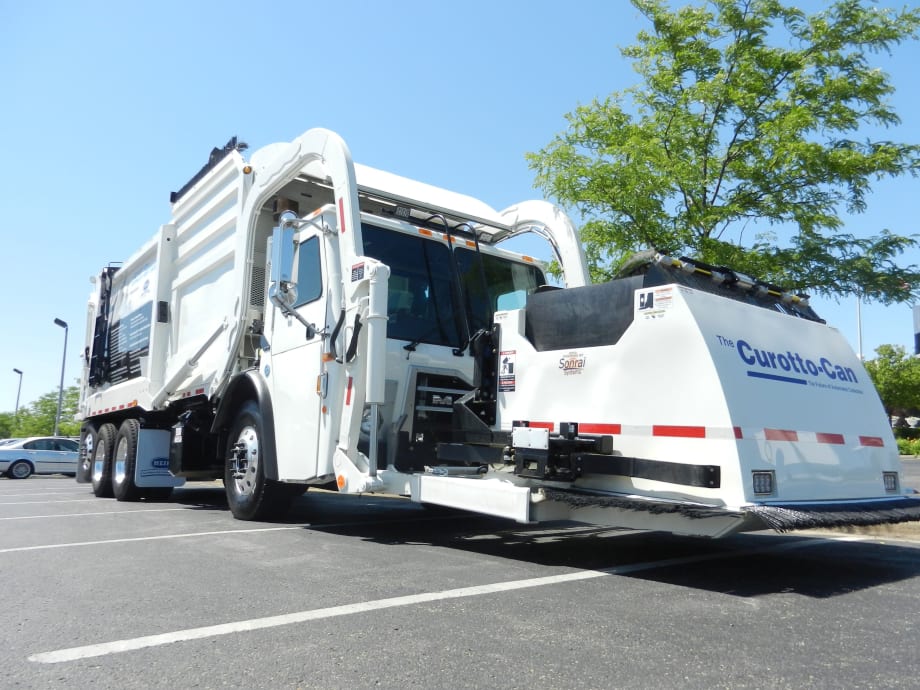
The Heil Odyssey Freedom front loader has a low body weight, which allows it to haul more trash, according to the company. Photo courtesy of Heil
Productive, fuel efficient, clean, and long-lasting — the qualities a fleet manager looks for in a passenger vehicle are no different than those they seek in a refuse truck. It’s no wonder, then, that the latest trends in the world of refuse trucks mirror those desired qualities. Here are the latest changes and improvements for these fleet workhorses.
Increased Productivity
Who doesn’t want a fleet unit that does more? Through improved technology, refuse truck manufacturers are finding ways to make their trucks more productive.
Hauling More
Refuse trucks have legal payloads — so when the truck is lighter, more trash can be hauled. One new trend is reducing body weight so more trash can be collected before returning to the landfill.
“Weight reduction is always a focus in the design of refuse trucks and a key factor in determining how much trash can be hauled,” said Anthony Henson, director of mobile products, Heil Environmental.
Running Faster
Refuse trucks often have sluggish starts. But if those starts were each a little faster, couldn’t a truck do more? Parker Hannifin’s RunWise technology tells us the answer is yes.
“Instantaneous torque enables a quick launch without using the diesel engine, which increases the amount of stops on a typical refuse route,” explained Angelo Caponi, sales specialist, Parker Hannifin, Hybrid Drive Systems Division. With minimal lag time between pressing the throttle and propelling forward, truck productivity increases.
Staying Behind the Wheel
Trash is always loaded in the rear of the truck, right? Not anymore. Today, some models are transitioning to automated front loading. The transition to using 96-gallon cans has lent itself to automation collection, which in turn has reduced the number of rear load trucks being purchased. But automated front loading can also improve productivity, as it reduces the number of times a driver must leave the truck. The more a driver stays behind the wheel, the more stops he or she can make in any given time.
“Automated collection trucks greatly improve productivity and safety by eliminating the number of times the driver is required to get out of the truck,” Henson said.
Extended Hours
An unexpected productivity booster? Noise reduction. Noise ordinances can prevent loud refuse trucks from collecting trash at certain hours. Take away that noise, and trucks can operate in a larger window of time.
“Electric garbage trucks are quiet, so they can pick up garbage earlier in the morning or late at night, outside of the hours often allowed to non-electric refuse trucks,” said Jim Castelaz, founder and CEO, Motiv Power Systems.
Reduced Downtime
Telematics is another trend hitting the refuse truck scene. Through wireless monitoring, fleet managers are alerted about vehicle performance in real time. Telematics data can help fleet managers keep an eye on driver productivity by ensuring they stay on assigned routes and spend the appropriate amount of time at each stop. Diagnostic data can also help fleet managers reduce downtime.
“Municipalities are starting to offer trucks with real-time wireless monitoring to assess any issues during a truck’s route in real-time,” Caponi said.
More Alternative Fuel Options
Just as alternative fuels are growing in popularity among passenger fleets, so are they in refuse truck fleets.
CNG
Compressed natural gas (CNG) for refuse fleets is becoming more widespread among government fleet agencies. For instance, Salt Lake County, Utah, runs CNG refuse trucks and plans to increase its CNG refuse fleet. Likewise, the City of Tacoma, Wash., is converting its refuse fleet to run on CNG and will install a time-fill station to support the vehicles.
Electric
In 2012, the City of Chicago broke ground as the first municipality to run an all-electric refuse vehicle (ERV). Using the Motiv electric Powertrain Control System (ePCS), the truck was equipped with battery packs to power the vehicle itself and the hydraulic system. The ERV has a 60-mile range, a payload capacity of nine tons, and 1,000 lbs. per cubic yard of compaction.
“The benefits of electrification are reduced fuel cost, reduced maintenance cost, and a better work environment for the drivers, workers, and residents by eliminating fossil fuel engines,” Castelaz said.
Anaerobic Digestion
Anaerobic digestion is a process that converts organic wastes such as normal food and yard waste into biogas, which can be processed into clean, efficient CNG fuel.
“We are seeing a growth in interest from progressive-minded haulers to utilize anaerobic digestion and CNG fleet conversions to improve their sustainability goals,” Henson with Heil said. “This is an area we expect to see more growth in the future.”
One government fleet using anaerobic digestion to fuel its refuse trucks is the City of Sacramento, Calif., which began using the renewable natural gas in 2013.
Hydraulic Hybrid
With this technology, conventional transmission and controls are replaced by a hydraulic hybrid drive system in conjunction with a diesel engine. Energy is stored in high pressure accumulators when the driver presses the brakes, which means the more stops, the more energy.
“With RunWise’s hydraulic hybrid drive technology, fuel consumption is reduced by up to 50%,” Caponi said. Considering the average refuse truck burns 8,600 gallons a year, this means hydraulic hybrid-equipped trucks can save up to 4,300 gallons of fuel a year. Capturing otherwise lost brake energy also means the vehicle does not have to consume fuel in routes below 40 mph.
Longer Life
Refuse trucks are a major investment, so fleets will be glad to know manufacturers are finding ways to extend the life of this equipment.
Improved Materials and Systems
Improved cylinder technology, electrical and hydraulic systems, and use of high-grade steel have extended the life cycle of refuse equipment. “Today a typical refuse truck can, depending on application and total cycles, operate up to 10 years or longer in some cases,” Henson said. “Proportional controls and more efficient hydraulic systems are new features that Heil has incorporated into our product offerings. These improved systems reduce operating temperatures, increase performance, and eliminate high maintenance costs. Eliminating items such as proximity switches, mac valves, and the relocation of the hydraulic valves off the front head of the equipment significantly reduces unit downtime and operating costs.”
Reduced Wear
Hydraulic hybrid drive technology can extend truck life, too, as it reduces engine use. With fewer demands on the engine, engine life is extended — and maintenance and downtime are reduced as well. “Current commercial RunWise truck owners report 98% uptime,” Caponi said.
Just as hydraulic hybrid drive technology extends engine life, regenerative braking in the ERV also prolongs brake life through reduced wear and extends driving range. Battery life is also extended by Motiv’s ePCS. “Large urban municipal fleets that we talked to use their refuse trucks from seven to 12 years. Batteries on an electric refuse truck will last this lifetime without needing replacement or maintenance,” Castelaz said.
Hydraulics on Demand
Hydraulics on demand, a load sensing system where hydraulics only operate when needed, reduces hydraulic pump power usage, saving electrical power and hydraulics system wear. “Some of the on-demand hydraulics systems improve fuel efficiency,” Castelaz said. “These systems, when applied to an electric refuse truck, save electricity and enable further range.”