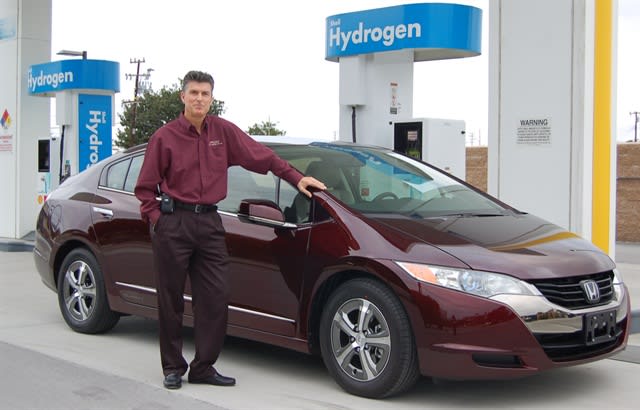
Honda's Fuel Cell Marketing Manager Steve Ellis with the 2012 model FCX Clarity at the Shell hydrogen fueling facility in Torrance. Click on the image for more pictures.
The introduction of hydrogen fuel cell cars into the market has been pushed back before. But now, with at least four major automakers announcing fuel cell vehicle releases in the next few years (and some already with leases in select markets), is the hydrogen vehicle now ready for a debut?
Steve Ellis, manager of fuel cell marketing at Honda, thinks so. He graciously offered to let us test out the Honda FCX Clarity last week, provided hands-on fueling training, and answered some questions. Here’s my take on the experience of driving and fueling a hydrogen car.
The car: This car drives just like a “regular” car, which is important. We drove around the city and on the freeway and I didn’t notice any major differences from the gasoline-powered sedan I drive. The dashboard has a fancy circular green and blue meter that measures battery power and fuel-cell stack power. Fuel efficiency is excellent. Honda estimates 60 mpg combined highway/city for a 5,000 PSI fill, but we got 63 mpg. The vehicle was surprisingly roomy, although the hydrogen fuel tank intrudes into the truck space by quite a bit. There’s a whirring noise (which sounds like an ambulance) that the Honda team is still working on, but that’s a minor issue.
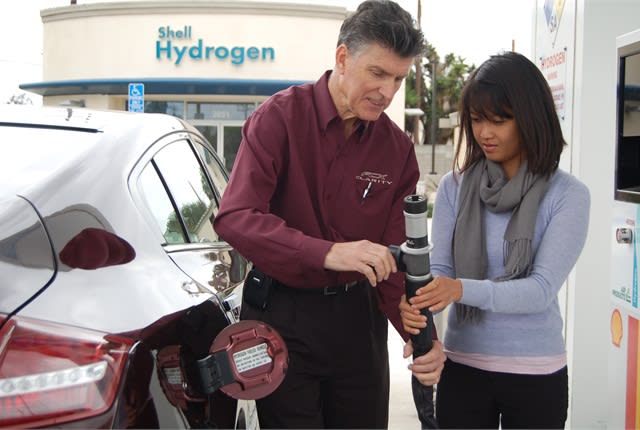
Steve Ellis shows me how to fuel. Click on the image for more pictures.
Fueling: Fueling is something any driver could easily get accustomed to. Currently, you get a PIN from Honda that you input to allow access to hydrogen fuel (which is free for now, by the way). The nozzle looks something like a natural gas nozzle. You lock it in by turning a lever on the nozzle and fueling begins automatically. We fueled a half-full tank in about three minutes or so (a full tank is 4 gallons). And if you’re worried about cost, Ellis estimates per-gallon cost will be about double the cost of gasoline when stations start charging for fuel – but he’ll be quick to remind you that the FCX Clarity is three times as efficient as an internal combustion engine saying, “Your net out of pocket per mile cost should be less than gasoline.”
Infrastructure: Fueling infrastructure for centralized fleets perhaps is not as much of a problem as it is for retail customers, whose vehicles may travel away from a nearby fueling station for an extended period of time. But, fear not, Ellis says. The California Fuel Cell Partnership has published a plan outlining a pathway to bring fueling infrastructure to California, with the goal of having 68 24/7 publicly accessible stations open in 2016.
“That date aligns with the timing automakers are saying the introduction ramp-up will begin,” Ellis says.
These stations will mostly be concentrated in the Los Angeles/Orange County area and the San Francisco Bay Area, with additional “connector” and “destination” stations. About a dozen of these are already up and running, while many more are already funded. If everything goes as planned, the “fueling problem” in California could be fully addressed. The California infrastructure system, if successful, could then be copied across the nation.
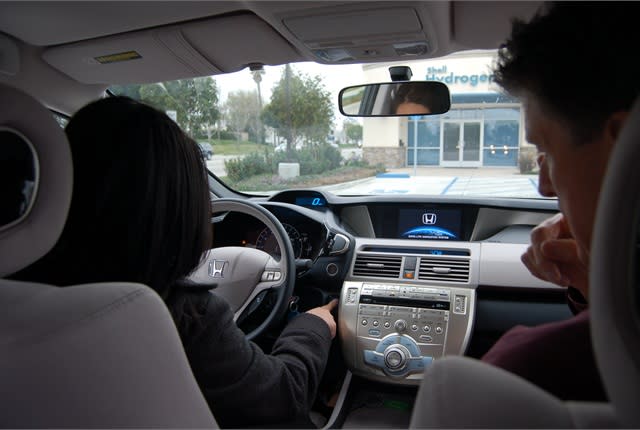
Honda's Steve Ellis shows Green Fleet Senior Editor Grace Suizo the car's features before the test drive. Click on the image for more pictures.
Range: The FCX Clarity has an EPA certified range of 240 miles, with a 5,000 PSI tank holding four gallons. Honda’s math shows just switching to a 10,000 PSI fuel storage tank could increase range to about 360 miles, and Ellis says that increasing fuel pressure is just one of the options Honda has available to increase range.
Cost: It’s not going to be cheap, and Honda hasn’t made any official announcements about pricing. However, Ellis says the price point of future fuel-cell vehicles “will likely be similar to battery-electric cars (BEVs), or if they are larger and more luxury-like, such as this FCX Clarity, they might be even more expensive.” And since some fleets are purchasing EVs, it doesn’t seem like too much of a stretch to try out a hydrogen-fueled vehicle or two, especially if grants and incentives lower that cost.
And finally: Ellis says the approximately two dozen people who are leasing the Clarity are very happy with it. And yes, fleet technicians will need additional training for maintenance, but according to Ellis, any technician already trained on hybrids or BEVs is about 80% trained on maintaining the fuel-cell car. “Hybrid and battery EV technicians have surpassed their apprenticeship status when it comes to working on fuel-cell vehicles,” he says.
We know the benefits of fuel-cell cars – zero tailpipe emissions, range equivalent to that of a gasoline vehicle, fast refueling time, and abundant domestic fuel sources – but are they enough to outweigh the costs? Is the fuel-cell vehicle ready to compete with the other alt-fuel cars on the market? What are your thoughts?