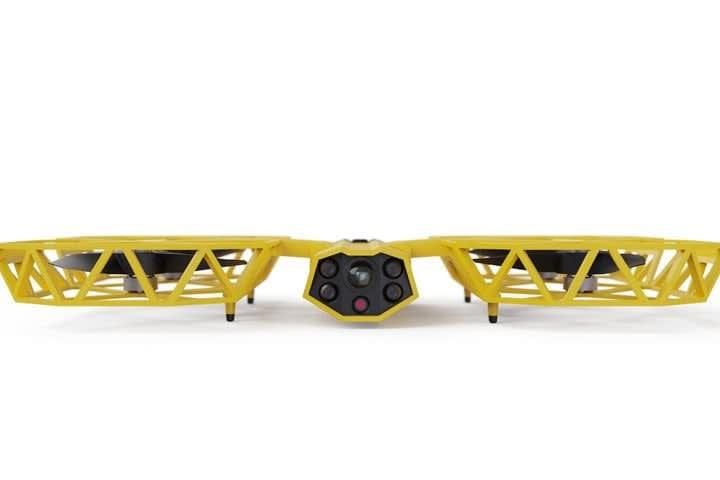
Axon is working on the development of a non-lethal, remotely operated TASER drone system for active shooter response.
The company says the non-lethal drone is part of a three-part strategy to stop mass shooter events, including:
1. Integrating camera networks and other sensors into real-time communications with first responders.
Axon recently announced a partnership with Fusus, which allows schools, businesses, or other enterprises to easily connect and share security camera feeds with local public safety and other security partners. With this integration, Axon body cameras, Axon Fleet dashboard cameras, and Axon Air-powered drones with the Fusus network will provide real-time access to a wide network of sensors during critical events. Fusus gives full and secure control of data sharing to the owner of each camera and sensor, so they can choose exactly when access is shared and with whom. This is available today through the partnership with Fusus.
“Trying to find and stop an active shooter based on the telephone game connecting victim 911 callers is antiquated,” said Chris Lindenau, CEO of Fusus. “Fusus brings the ability to share any security camera to first responders, providing known locations and visual live feeds regardless of which security cameras they use. This network of cameras, with human and AI monitoring, together with panic buttons and other local communication tools, can detect and ID a threat before a shot is fired and dramatically improve response times and situational awareness.”
2. Enhancing first responder effectiveness through immersive Virtual Reality (VR) active shooter response training.
Axon recently launched Virtual Reality Simulator Training to provide highly immersive and engaging training experiences for public safety. Through partnerships with key expert and stakeholder groups, Axon will develop and deliver more effective training for responding to mass shooting events in the next 12 months.
3. Enabling immediate threat incapacitation through remotely operated, non-lethal drone capability.
Axon is actively developing a miniaturized, lightweight TASER payload capable of being deployed on a small drone or robot. Axon has begun collaborating with its partner DroneSense on a remote piloting capability and the company's imaging team is developing the targeting algorithms to assist operators in properly and safely aiming the device. Note that all use-of-force decisions will be made by an authenticated and authorized human operator who has agreed to take legal and moral responsibility for any force actions initiated. Axon is collaborating with a variety of drone hardware providers and will make a selection later this year on a final development partner or partners. Functional proof of concept will be available in 2023 with a full solution ready in 2024.
“Today, the only viable response to a mass shooter is another person with a gun,” said Axon CEO and founder Rick Smith. “In the aftermath of these events, we get stuck in fruitless debates. We need new and better solutions. For this reason, we have elected to publicly engage communities and stakeholders, and develop a remotely operated, non-lethal drone system that we believe will be a more effective, immediate, humane, and ethical option to protect innocent people.
“There are over 10 million fire hydrants pre-emplaced in the United States, and every modern building has fire suppression systems to contain fires until fire-fighters can arrive,” Smith noted. “I believe we can create systems that can detect, deter, and ultimately stop a shooter within a building for a comparable cost as, or less than, fire suppression systems.”
To ensure the safe, responsible, and transparent deployment of this technology, Axon is integrating the Authentication, Authorization, and Accountability (AAA) Control System. This comprehensive framework ensures only approved and highly trained users can operate and activate the system, and that an end-to-end audit trail is retained, providing 100% transparency on the deployment and engagement of every remotely operated TASER system. The AAA Control System is key to implementing Axon’s 3 Laws of First Responder Robotics. These three laws developed in discussions with various experts, stakeholders, and the general public will continue to evolve to ensure Axon understands and mitigates risks associated with this new technology to the greatest degree possible.
Axon’s Three Laws of First Responder Drones
1. Humans must own decisions and remain accountable. Robots must be controlled by authenticated human operators who accept legal and moral responsibility for any decision that impacts a human subject.
2. Drones should be used to save lives, not take them. Operators of drones who are not in immediate danger are duty bound to de-escalate whenever possible and deploy the minimal force necessary. Only non-deadly force should be used.
3. Agencies must provide rigorous oversight and transparency to ensure acceptable use. Institutions operating robots capable of deploying force must develop publicly available policies describing in advance the types of circumstances in which robots should be deployed. Every incident of force deployed from a robotic system shall be recorded with audio-video and operational data to be reviewed by an oversight committee.
The Axon AI Ethics Board has reviewed police use of remotely operated, non-lethal drones, prior to the mass shootings in Buffalo and Uvalde. The majority of the board voted to advise Axon not to proceed and plans to issue a report in the Fall of 2022. However, given these tragic mass shootings, Axon has asked the board to re-engage and consider issuing further guidance and feedback on this capability.
To evaluate this technology’s impact on communities, Axon will work with its Community Advisory Coalition (CAC). Formed in 2021, the CAC brings together community leaders to share diverse perspectives and inform Axon’s products and services.
The effort to detect and stop mass shooting events will require a wide range of partnerships to bring the best possible technology to bear.
This story originally appeared in Police Magazine.