
Red Government Fleet with star logo
MenuMENU
SearchSEARCH

BRINC, Echodyne Partner to Simplify Drone as First Responder Programs

The partnership will integrate BRINC’s Drone as First Responder solution with Echodyne’s ground-based radars to enable a path toward Beyond Visual Line of Site operations without Visual Observers.

BRINC, Echodyne Partner to Simplify Drone as First Responder Programs

The partnership with Echodyne will add a layer of safety and reliability while providing a path for BRINC’s customers to meet the stringent FAA requirements for BVLOS operations without a visual observer.

Photo: BRINC

2 min to read


BRINC, a provider of drone technology for first responders, is partnering with Echodyne, a company that offers ground-based radar systems. The collaboration will integrate Echodyne’s MESA radar technology into BRINC’s purpose-built Drone as First Responder (DFR) solution.

The relationship enables a path toward beyond-visual line of sight (BVLOS) operations without visual observers, advanced airspace awareness for safer operations, and lowers the barrier to entry for public safety agencies looking to start or expand DFR programs.

The Benefits of DFR Systems for Fleets

DFR systems significantly lower emergency response times and enable more informed decision-making for first responders. By giving law enforcement officers and other responders a view of developing scenes before arriving, DFR systems allow them to determine the safest response method.

They also allow first responders to decide whether to deploy additional aid like specialty vehicles.

Aiding in Potential DFR Barriers
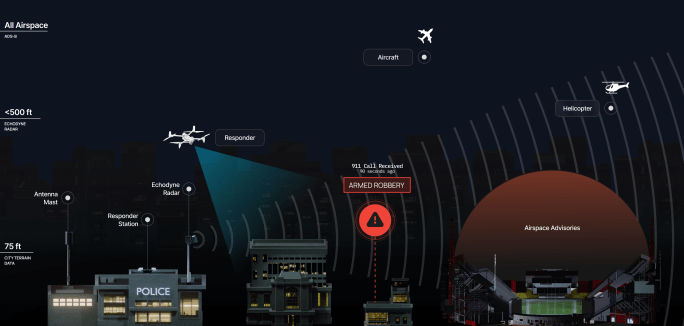
A visual shows Echodyne's setup in a hypothetical city setting with an armed robbery. The drone is shown, along with nearby aircraft and airspace advisories.

BRINC Integrates Echodyne’s hardware to send radar readings to an agency’s connected LiveOps account. From LiveOps, agencies can simultaneously view their drone operations, ADS-B data, airspace advisories, weather conditions, and radar data.

Photo: BRINC

Current FAA regulations require a visual observer to be onsite for drone operations to monitor flights. This limits drones, flexibility, and operating times for emergency response operations.

It can also put a strain on staffing when public safety agencies across America are understaffed. DFR requires extended range and operation in obstructed environments and inclement weather.

BVLOS waivers are essential for successful DFR implementation. The partnership with Echodyne will add a layer of safety and reliability while providing a path for BRINC’s customers to meet the stringent FAA requirements for BVLOS operations without a visual observer.

“By combining BRINC’s drone technology with Echodyne’s advanced radar, we are creating a safe, robust, and reliable solution for first responders to deploy 911 response drones autonomously to emergencies,” BRINC CEO Blake Resnick said.

Echodyne’s radar systems offer continuous monitoring and real-time data on the drone's surrounding environment, including the location of other aircraft, obstacles, and dynamic changes that can occur at a moment's notice, according to a news release.

“Echodyne radars have been used for years by UAS centers of excellence, as well as FAA and NASA testing programs,” Echodyne CEO Eben Frankenberg said. “DFR represents a unique opportunity to introduce widescale BVLOS operations, and radars are the ideal sensor to provide detailed and accurate airspace situational awareness.”

How the Tech Integration Works

As part of BRINC’s DFR offering, BRINC Integrates Echodyne’s hardware to send radar readings to an agency’s connected LiveOps account. From LiveOps, agencies can simultaneously view their drone operations, ADS-B data — which shows an aircraft's position and identity — airspace advisories, weather conditions, and radar data.

The Echodyne addition provides an all-in-one view of the surrounding airspace, enabling automated LiveOps triggers to inform pilots of potential dangers. It also enables the automated grounding or rerouting of drones to avoid air traffic.


More Police

Policeby Jeanny RoaFebruary 4, 2026

Addressing Fueling Failures to Reduce Operational Risks

Working to eliminate errors and challenges and increase reliability during fueling, the Madison County Sheriff’s Office has implemented RoadFlex for its 37-vehicle patrol fleet.

Read More →
Policeby Nichole OsinskiJanuary 26, 2026

PUG: When Policing Goes Autonomous

How an uncrewed police ground vehicle is providing technical assistance to the Miami-Dade Sheriff’s Office through a pilot program with the goal of supporting officers and reducing crime through increased marked police presence.

Read More →
Policeby Staff WriterJanuary 20, 2026

Applications Open: 2026 Police Fleet Innovators Award

The Police Fleet Innovators Award is for fleet operations teams that have come up with innovative solutions to common problems in law enforcement fleets. Click for deadline details, plus an award FAQ.

Read More →
Ad Loading...
SponsoredJanuary 19, 2026

Basic Tracking vs Next Generation Fleet Technology

Fleet software is getting more sophisticated and effective than ever, tying big data models together to transform maintenance, safety, and the value of your existing tech stack. Fleet technology upgrades are undoubtedly an investment, but updated technology can offer a much higher return. Read how upgrading your fleet technology can increase the return on your investment.

Read More →
a bullet board with police pictures of vehicles plus handcuffs and police tape.
Policeby Nichole OsinskiDecember 26, 2025

Police Fleets in 2025: Stories That Defined the Year

What did police fleets actually wrestle with in 2025? We highlight the most impactful stories on vehicles, funding, technology, and operations, distilling the key takeaways for fleet and command staff.

Read More →
University of Tennessee at Chattanooga Police SUV parked outdoors, displaying updated blue-and-gold graphics, police markings, and university identification.
Policeby News/Media ReleaseDecember 24, 2025

New UTC Police Cars Hit the Campus Roads

The University of Tennessee at Chattanooga Police and Public Safety has updated the graphics and branding across its vehicle fleet.

Read More →
Ad Loading...
A newly delivered red Airbus H125 helicopter marked “Sheriff” and “Erie County” inside an Airbus facility.
Policeby News/Media ReleaseDecember 18, 2025

Davenport Aviation Delivers New Airbus H125 Helicopter to Erie County Sheriff’s Office

Erie County adds its first of two Airbus H125 helicopters, boosting aviation readiness and public-safety response capabilities.

Read More →
PoliceDecember 10, 2025

Weather Protection Strategies For Public Safety Fleets

How Mansfield PD addressed weather-related risks to its patrol vehicles, and what fleets need to know about planning and specifying protective structures for similar conditions.

Read More →
Row of newly designed Indiana State Police Dodge Durango patrol vehicles parked outdoors, marking the rollout of the new fleet design for graduating troopers.
Policeby News/Media ReleaseDecember 2, 2025

Indiana State Police Troopers Receive New Look Dodge Durango Patrol Vehicles

Indiana State Police rolls out its first fleet of newly redesigned Dodge Durango patrol vehicles as 20 probationary troopers from the 87th Recruit Academy begin service across the state.

Read More →
Ad Loading...
Policeby Staff WriterDecember 1, 2025

Michigan State Police 2026 Vehicle Testing Results

2025 MSP vehicle tests revealed standout police cars, from EVs to pursuit-ready SUVs.

Read More →