As the Government Fleet Expo & Conference approaches, attention turns to three standout professionals who exemplify excellence in public sector fleet management. The finalists for the 2025 Public Sector Fleet Manager of the Year award have been announced, offering a chance to recognize the innovation, strategy, and dedication that continue to elevate the industry as a whole.
Now in its 21st year and sponsored by Element Fleet Management, the award honors fleet managers who demonstrate outstanding performance across a range of critical areas — from business planning and technology integration to preventive maintenance, customer service, and fuel management. Each finalist has made a measurable impact on their agency and the communities they serve.
The winner will be announced during The Honors Celebration at GFX, taking place from June 24 to 27 in Charlotte, North Carolina. Until then, here’s a closer look at the 2025 contenders and the accomplishments that earned them a place among the top three.
Who is up for the big award in 2025? Here’s a little more information about them:
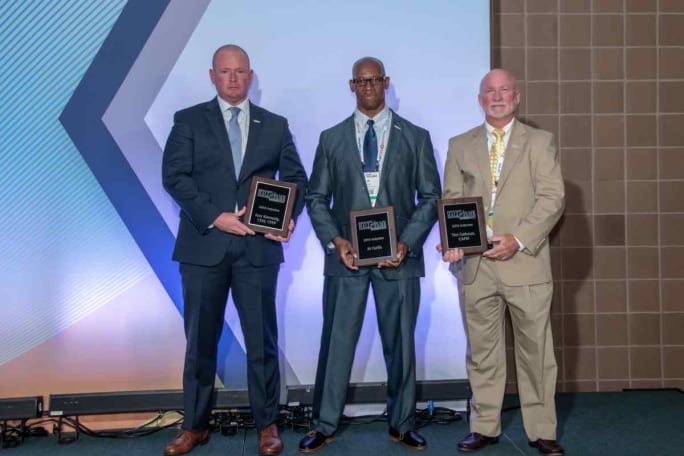
Kevin Myose and the San Joaquin County fleet team.
Photo by Yvette Ponthier
Kevin Myose, MBA, Fleet Manager, San Joaquin County, California
Time Spent in Fleet: 34 years
How You Got Started: Hired at the County of Sacramento as a stock clerk.
Enjoyable Aspects of Your Job: Solving problems, enabling happy employees and customers, participating in Municipal Equipment Maintenance Association (MEMA) and industry events. Integrating innovation into our processes. Making a difference!
Biggest Challenges: Rising costs of everything – vehicles, parts, supplies, and fuel. Conforming to state laws concerning EV adoption and operation. Funding EV transition. Underutilization and customer behaviors.
Upcoming Exciting Projects: EV transition, EV charging infrastructure, restructuring of Fleet organizational chart, job descriptions, and span of control.
What Colleagues Might Not Know About You: My wife and I have a Chihuahua that we love to bring with us when we take trips in our travel trailer.
Favorite Fleet Memory: Successfully hosting our first American Public Works Association, National Public Works Week, San Joaquin County Public Works Employee Car, Bike, And Truck Show in 2010. We are hosting our 14th show this year. Employees bring their rides and compete for awards. Attended by 350 to 400 employees each year.
Best Advice: Practice servant leadership, care about people, happy employees enable happy customers. Provide employees with the best tools, equipment, and training. Celebrate wins and seek to resolve problems without blame. Treat others as you want to be treated. Work on vehicles as if your mother drove them. And a few more things: Perform your own glass chip repair instead of farming it out. You will achieve ROI after 10 repairs. Participate in industry events and make connections, share your success and failures. Ask other fleet professionals how they are resolving common fleet issues. Treat your vendors like customers and recognize their contribution to the success of your fleet.
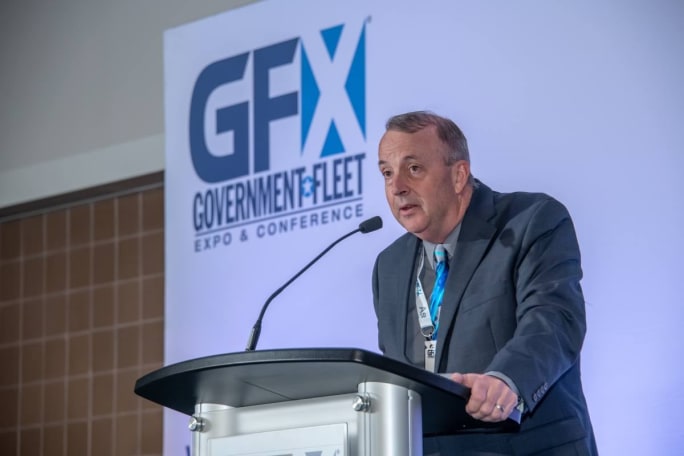
Alison Kerstetter and Fleet Management members of the Main, Service, and Build Shops.
Photo by Yvette Ponthier
Alison Kerstetter, MBA, Fleet Manager, City of Sacramento Department of Public Works
Time Spent in Fleet: I’ve been in fleet for 10 years and 5 years in the transportation industry.
How you got Started: I started in fleet in the City of Sacramento in the Department of Utilities as a Program Analyst, being a liaison to Fleet and Facilities Management. Utilities had roughly 500 vehicles and equipment, and I was responsible for tracking the replacement vehicle budget, speaking with end users and Fleet Management regarding specifications, and being the main contact for the department for all things fleet.
Enjoyable Aspects of Your Job: I am very fortunate to work with a great group of people in fleet as well as in the city, all who want to do the best for the citizens as well as their co-workers. Also, I learn something new in this position every day. There are learning opportunities in every aspect of shop operations, vehicle specifications, personnel management, and budgetary decisions.
Biggest Challenges: There are multiple challenges that we are currently facing with the City of Sacramento fleet. One of the challenges is complying with the state regulations that have been adopted by the Air Resources Board. The Advanced Clean Fleet regulation requires fleets to reduce emissions through purchasing zero emission vehicles (ZEVs). The Clean Truck Check requires that all non-gasoline vehicles over 14,000 GVWR are reported with a compliance fee and submission of emission compliance tests multiple times a year. Other challenges, such as aging infrastructure, specifically fleet maintenance shop equipment such as vehicle lifts, exhaust systems, and larger tools must be repaired and updated to continue efficient operations. Recruitment and retention of staff is another issue that is relevant in today’s industry for all fleet management groups. New ideas for recruiting and making the shops a better place to work are necessary to continue to keep positive staff members.
Upcoming Exciting Projects: An exciting project that the Fleet Management team has been working on for the last year and a half is updating and repairing shop infrastructure. The team was able to make the case to secure funding during the budget process in the current fiscal year and hoping to do the same for the next fiscal year. We have purchased and installed 5 in-ground vehicle lifts and purchased a set of 6 mobile lifts this fiscal year. We are working on repairing the diesel exhaust system in our three largest shops.
What Colleagues Might Not Know About You: I played the clarinet and tuba in high school.
Favorite Fleet Memory: My favorite fleet memories include the different learning opportunities that I’ve had on the job. I enjoy attending pre-delivery inspections, touring manufacturing facilities, and learning about different equipment like hydro-excavators, fire trucks, and rodders. Visiting job sites is extremely valuable to learn about the activities and tasks that our internal customers complete, so I understand what is required for the vehicle or equipment that fleet purchases and maintains. However, the best memory is working in the fleet maintenance shops to have first-hand knowledge of what the fleet technician staff and shop office staff deal with on a daily basis and getting to know fleet staff members.
Best Advice: Speak to everyone at every level of your organization. Specifically, for fleet, speak to service workers, senior mechanics, supervisors, and administrative staff. It is the best way to understand what the organization needs and what staff require to get their jobs completed. This helps with providing the team with their needs as well as assists in learning about your staff and letting them know that they can approach you if they have questions or any issues.
Ross Jackson Jr. and the City of Fayetteville fleet team.
Ross Jackson Jr., CAFM, Fleet Operations Superintendent, City of Fayetteville, Arkansas
Time Spent in Fleet: 22 years in the fleet and automotive industry; 24 years if you count the two years of trade school working on college vehicles and customers that received free work so we could get experience. In trade school, our payment for our labor was always pizza.
How You Got Started: Right out of high school, I wanted to follow in my father’s footsteps and become a police officer—he served for 30 years. I even started college pursuing a degree in Criminal Justice. Around that time, a friend asked me to help work on his 1967 Ford Mustang GT Fastback. That moment changed everything for me—I was hooked on the world of mechanics. I enrolled in trade school and was honored to receive the Nissan Student of the Year award. Nissan sponsored our program and provided newer vehicles for us to train on.
One of my professors connected me with a local Nissan dealership, where I started out changing oil. From there, I completed Nissan OEM classes and became a certified Nissan technician. During the housing crisis, work slowed down. Our GM instructed the service manager to split the mechanics into two teams. The team that billed the most flat-rate hours would keep their jobs. Thankfully, my team and I put in the work and made the cut. It was around that time I learned about an opening at Placer County, California, Fleet Operations that offered job security and better benefits. I worked at Placer County Fleet for 14.5 years, working in various roles. However, the long winters, daily commutes, and being away from my family from November through April each year made my family consider a change.
I left my role as a Master Equipment Mechanic in Placer County and moved to Arkansas with the goal of pursuing a fleet management position. The slower pace and more affordable land also played a big role in our decision. I eventually joined the University of Arkansas as their Fleet Manager for a little over a year, where we built a top-tier team.
When the Fleet Manager position opened at the City of Fayetteville, I jumped at the opportunity. The role offered a more diverse fleet and a more competitive compensation package. Fayetteville has a very diverse fleet of close to 750 vehicles supporting all city operations, including Police, Fire, Recycling and Trash, Transportation, Airport, Water and Sewer, with both on-road and off-road vehicles. Nearly three years in, leading the incredible City of Fayetteville team has been the most rewarding experience of my 20+ year career in the industry. Together, we work hard to support our community, and I couldn’t be prouder of the work we do.
Enjoyable Aspects of Your Job: I love all aspects of my job at the City of Fayetteville. We have an incredible team and a very supportive city administration. Fleet management is something new each day, the challenges, projects, collaborations, and being able to be a part of each department’s mission, I find very rewarding.
Biggest Challenges: Some of the biggest challenges were when I came on board at the city. PM compliance needed a lot of attention. The police department was unhappy with how long it took fleet to upfit and repair vehicles. Check engine light normalcy across the fleet was an issue, communication from fleet to all the departments needed help. The FMIS was not being utilized to its full potential and the mechanics needed to be shown how to use it to capture the data. The vehicle and equipment downtime was a large challenge to all the departments being able to fulfill their missions. We really needed to establish a healthy culture, goals and realize our mission was an extension of all the other departments. We as a team have made huge progress in all these areas and we are proud of our accomplishments.
Upcoming Exciting Projects: Personally, really learning to continue to be a better fleet manager and leader. As a fleet, continuing to integrate telematics and AI into the daily workflows. Finding new ways for these technologies to create efficiencies and cost savings. Continuing to digitize and modernize workflows and DVIRs. Moving the culture of equipment care beyond fleet and continuing to build that with all the operators. We have seen a lot of buy-in, which is really a game changer. Continuing to grow our EVSE and EV replacements when utilization and the data show it makes sense and will work for the application, without affecting customers and city services.
What Colleagues Might Not Know About You: I love gardening, reading, extremely spicy food, and recently found that I love owning a wiener dog.
Favorite Fleet Memory: Even though I moved away from it purposely, I loved working in beautiful Lake Tahoe. Going on road calls around the Northlake in the winter was always an adventure. Seeing houses and cabins with snow stacked beyond the second story or up to the power lines was an incredible sight each winter. I worked with some of the best mechanics, fabricators, and operators I will probably ever meet. When you work in the middle of nowhere, highways are closed, parts are hard to get, the equipment may be too old to have even parts available, which makes you have to overcome serious obstacles and grow in this trade.
Best Advice: Learn to collaborate, learn to communicate, learn all of your customers' missions, and value them. Spend time with your customers in the field to understand how their equipment is used. Learn the challenges your customers have to overcome. Provide ways to make their mission and yours easier based on what you see. Teach and model these things to staff. Above all, listen to your staff and their experience.