The U.S. Environmental Protection Agency has rolled out the strongest-ever pollution standards for passenger cars, light-duty trucks, and medium-duty vehicles for model years 2027 through 2032 and beyond. In addition to health benefits, the standards are expected to lead to cost savings for fleets and consumers alike.
The final standards deliver on the significant pollution reductions outlined in the proposed rule, announced in April 2023, while accelerating the adoption of cleaner vehicle technologies.
EPA is finalizing this rule as sales of clean vehicles, including plug-in hybrid and fully electric vehicles, hit record highs last year.
The updated standards will avoid more than seven billion tons of carbon emissions.
Breaking Down the New Standards for Light- and Medium-Duty Fleets
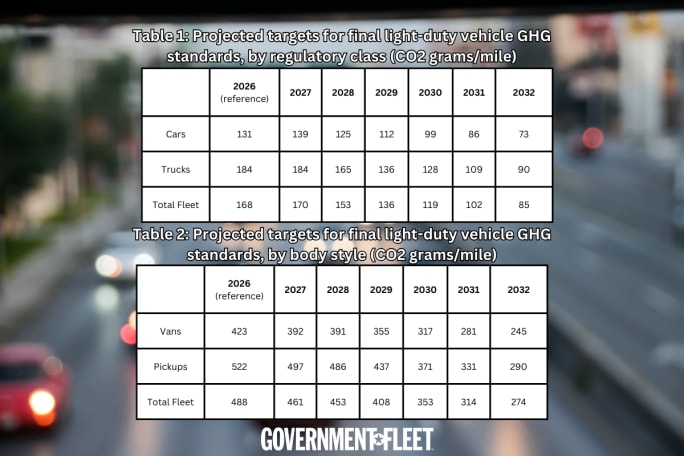
Table 1 shows a summary of the projected industry average targets for e light-duty GHG standards for MY 2027-2032 for cars, trucks, and the overall light-duty fleet. Table 2 presents a summary of the industry average targets projected for the medium-duty GHG standards for MYs 2027-2032, for vans, medium-duty pickups, and the medium-duty fleet overall.
Photo: EPA/Canva/Government Fleet
The final standards, called the “Multi Pollutant Emissions Standards for Model Years 2027 and Later Light-Duty and Medium-Duty Vehicles,” build on EPA’s existing emissions standards for passenger cars and light trucks for model years 2023 through 2026.
EPA is finalizing the same standard proposed for MY 2032 while allowing additional time for the auto manufacturing industry to scale up clean vehicle manufacturing supply chains in the first three years covered by the rule. This will be of benefit to public sector fleets in municipalities and states aiming to curb emissions.
The standards continue the technology-neutral and performance-based design of previous EPA standards for cars, pickups, and vans, and leverage advances in clean car technologies to further reduce both climate pollution and smog- and soot-forming emissions.
The transportation sector accounts for the largest source of greenhouse gas emissions in the U.S., according to the EPA.
The new light-duty vehicle standards are projected to result in an industry-wide average target for the light-duty fleet of 85 grams/mile (g/mile) of CO2 in MY 2032. This represents a nearly 50% reduction in projected fleet average emissions target levels relative to the existing MY 2026 standards.
The EPA is revising existing standards for medium-duty vehicles for MY 2027, establishing new standards for MYs 2028-2032, taking into account the increased feasibility of greenhouse gas emissions-reducing technologies in this sector in this time frame.
Compared to the existing MY 2026 standards for medium-duty vehicles, the final MY 2032 standards represent a nearly 44% reduction in projected fleet average GHG emissions levels.
How the Standards Are Meant to Help Fleets and Other Drivers
The new standards will provide nearly $100 billion of annual net benefits to society, including $13 billion of annual public health benefits due to improved air quality, and $62 billion in reduced annual fuel costs, and maintenance and repair costs for drivers and fleets, according to the EPA.
Annually, the net benefits to society for the light- and medium-duty final rule are estimated to be $99 billion. The final rule is expected to avoid 7.2 billion tons of CO2 emissions through 2055, roughly equal to four times the emissions of the entire transportation sector in 2021.
Fleet drivers who spend much of their time on the road will see benefits to the updated standards. The EPA reported they will reduce fine particulate matter and ozone, preventing up to 2,500 premature deaths in 2055 as well as reducing heart attacks, respiratory and cardiovascular illnesses, aggravated asthma, and decreased lung function.
In addition, the standards are expected to reduce emissions of health-harming fine particulate matter from gasoline-powered vehicles by over 95%.
The EPA received extensive feedback on the proposed rule, including through written comments, testimony at public hearings, and other stakeholder engagements.
The final standards were informed by the best available data in the public record and rigorous technical assessments.
Like the proposal, EPA’s final rule gives manufacturers the flexibility to efficiently reduce emissions and meet the performance-based standards through the mix of technologies they decide is best for them and their customers.
The agency's analysis considers a broad suite of available emission control technologies, and projects that consumers and fleet managers will continue to have a wide range of vehicle choices under the final rule, including advanced gasoline vehicles, hybrids, plug-in hybrid electric vehicles, and full battery electric vehicles.
Benefits to Auto Manufacturers and Workers
The EPA projects an increase in U.S. auto manufacturing employment in response to these final standards, consistent with the broader Biden-Harris Administration commitment to create good-paying, union jobs contributing to the clean vehicle future.
These standards will provide greater certainty for the auto industry, catalyzing private investment, creating good-paying union jobs, and invigorating and strengthening the U.S. auto industry, the EPA stated.
Over the next decade, the standards, paired with President Joe Biden’s Investing in America agenda and investments in U.S. manufacturing, will set the U.S. auto sector on a trajectory for sustained growth.
The United Auto Workers praised the standards, with a statement saying "The EPA has made significant progress on its final greenhouse gas emissions rule for light-duty vehicles. By taking seriously the concerns of workers and communities, the EPA has come a long way to create a more feasible emissions rule that protects workers building ICE vehicles, while providing a path forward for automakers to implement the full range of automotive technologies to reduce emissions.”
The final rule reflects the significant investments in clean vehicle technologies that industry is already making domestically and abroad, as well as ongoing U.S. market shifts and increasing fleet and retail customer interest in clean vehicles.
How OEMs Are Reacting
Statements by the Detroit Three were released after the finalized standards were announced. Here is how the three OEMs responded.
Ford Motor Company:
“We appreciate EPA’s efforts and collaboration in strengthening greenhouse gas emissions standards in ways that reflect the realities of the EV transition. The agency’s final rule is ambitious and challenging, and achieving its requirements will take close public-private cooperation. Ford will continue to lower emissions while offering our customers choices across hybrid, plug-in hybrid and fully electric vehicles that are highly functional and fun to drive – including America’s best-selling hybrid and fully electric trucks.”
General Motors:
“GM supports the goals of the EPA’s final rule and its intention to significantly reduce emissions. Although challenging, we believe our commitments and investments in an all-electric future place GM in an excellent position to contribute to the goals of the final rule. While we review the details, we encourage continued coordination across the U.S. federal government and with the California Air Resources Board to ensure the auto industry can successfully transition to electrification.”
Stellantis:
“Electrification is vital to our Dare Forward vision, which includes a genuine commitment to provide our customers with no-compromise driving experiences that also benefit the environment. While the later-year targets remain aggressive, the final rule improves on the proposal by better reflecting the expected trajectory of market demand and enabling infrastructure. It is critical that forthcoming rules align with this proposal so that US manufacturers can effectively comply with a single set of rules.”