Ford has designed a new heated software enhancement to pilot with its Police Interceptor Utility — one that law enforcement agencies across the country can utilize to help reduce the footprint of the COVID-19 virus.
This software solution is available immediately on all 2013-19 Police Interceptor Utility vehicles in the United States, Canada, and other countries around the world.
“First responders are on the front lines protecting all of us. They are exposed to the virus and are in dire need of protective measures,” said Hau Thai-Tang, Ford chief product development and purchasing officer. “We looked at what’s in our arsenal and how we could step up to help. In this case, we’ve turned the vehicle’s powertrain and heat control systems into a virus neutralizer.”
How It Works
The solution is simple: Bake the vehicle’s interior until viruses inside are inactivated. Using Police Interceptor Utility’s own powertrain and climate control systems, this software solution enables vehicles to elevate passenger compartment temperatures beyond 133 degrees Fahrenheit, hotter than Death Valley on its hottest day, for 15 minutes — long enough to help disinfect vehicle’s touchpoints.
Once activated, the vehicle’s powertrain and climate control systems work together automatically to elevate passenger compartment temperatures. The software warms up the engine to an elevated level, and both heat and fan settings operate on high. The software automatically monitors interior temperatures until the entire passenger compartment hits the optimal level, then that temperature is maintained for 15 minutes.
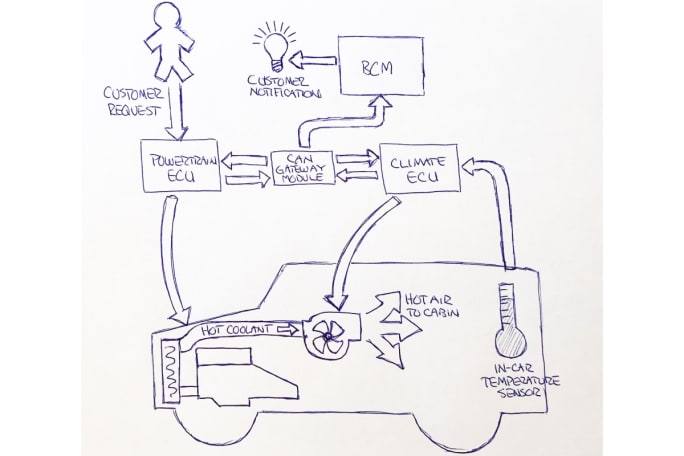
Once activated, the vehicle’s powertrain and climate control systems work together automatically to elevate passenger compartment temperatures.
Image: Ford
To research the effectiveness of this sanitization method, Ford worked closely with Ohio State University to determine the temperature and time duration needed to help inactivate the COVID-19 virus.
“Our studies with Ford Motor Company indicate that exposing coronaviruses to temperatures of 56 degrees Celsius, or 132.8 degrees Fahrenheit, for 15 minutes reduces the viral concentration by greater than 99% on interior surfaces and materials used inside Police Interceptor Utility vehicles,” said Jeff Jahnes and Jesse Kwiek, laboratory supervisors at the Ohio State University Department of Microbiology.
Law enforcement will have multiple ways to monitor progress. Hazard lights and taillights will flash in a pre-set pattern to notify when the process has begun, then will change at the end to signal completion. The vehicle’s instrument cluster will also indicate progress. A cool-down process brings the temperature down from its highest points.
This heated process can be used by law enforcement regularly to help sanitize vehicles when officers are not inside. When used in conjunction with sanitization guidelines approved by Centers for Disease Control and Prevention, flooding the passenger compartment with elevated air temperature can help reach areas that may be missed by manual disinfecting procedures. Heat has the ability to seep into crevices and hard-to-reach areas, helping reduce the impact of human error in applying chemical disinfectants.
Ford conducted software operational trials in vehicles owned by the New York City Police Department, Los Angeles Police Department, Michigan State Police, Massachusetts State Police, Boardman Township Police Department in Ohio, and Seminole County Sheriff’s Office in Florida.
The Need to Move Fast
The Ford engineering team initiated a project in late March to de-contaminate vehicles using heat. Shortly after, a discussion with the New York City Police Department alerted Ford to its need for a more efficient disinfecting process during the pandemic.
“Law enforcement officers are being dispatched as emergency responders in some cases where ambulances may not be available,” said Stephen Tyler, Ford police brand marketing manager. “During one trip, officers may be transporting a coronavirus patient to a hospital, while another trip may involve an occupant who may be asymptomatic.”
Used to supplement recommended cleaning methods, safely heating the passenger compartment can help ensure vehicles are properly disinfected before being deployed again.
“Officers can now use this self-cleaning mode as an extra layer of protection inside the vehicle in areas where manual cleaning is prone to be overlooked,” said Tyler. “This virus is an invisible enemy and we are proud to provide a solution to help the law enforcement community fight it.”
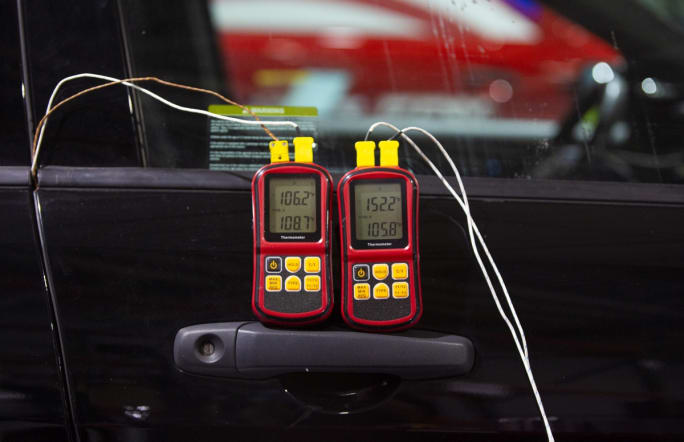
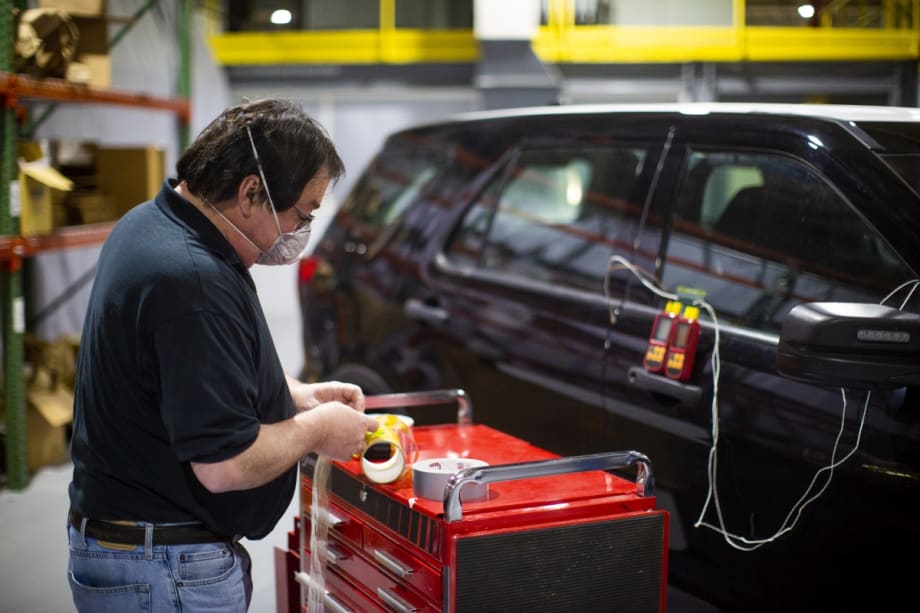
Using Police Interceptor Utility’s own powertrain and climate control systems, this software solution enables vehicles to elevate passenger compartment temperatures beyond 133 degrees Fahrenheit.
Photo: Ford
Initial Rollout
Large departments with their own service centers can install the software solution using their own diagnostic service tools, while other fleets can work with their local dealers to install the software for 2013-19 Police Interceptor Utility.
For 2016-19 police vehicles, the heated software process can be activated by a smart sequence of commands that involves pressing cruise control buttons in a predefined order. For 2013-15 vehicles, this mode can be activated and carried out through an external tool that connects to the onboard diagnostics port.
“Vehicles from the 2013 to 2019 model years make up the majority of Police Interceptor Utility vehicles currently in use by first responders,” said Tyler. “Delivering this new capability to these vehicles first allows us to help as many officers as possible, as quickly as possible.”
Ford will continue working on ways to bring this software capability to additional Ford police vehicles.