




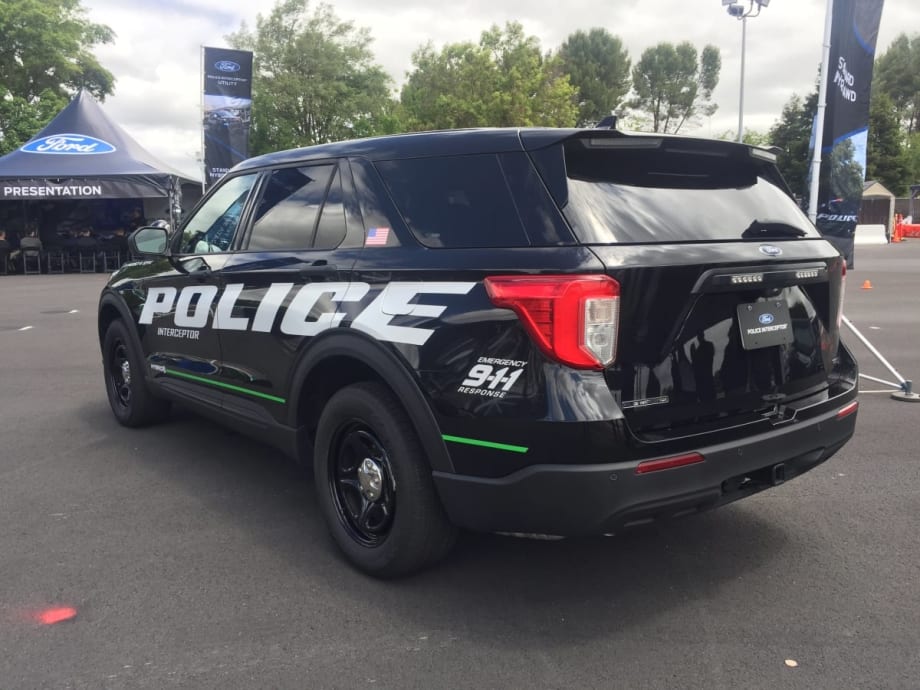
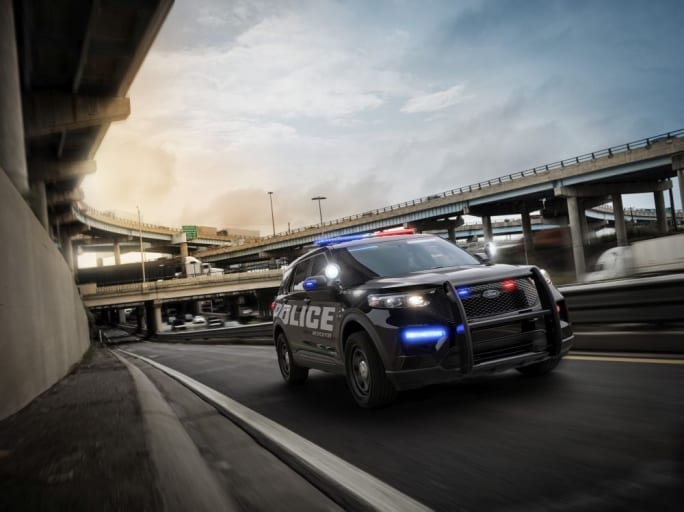
The 2020 Ford Police Interceptor Utility Hybrid has an EPA-estimated rating of 23 mpg city/24 mpg highway/24 mpg combined.
Photo courtesy of Ford
Ford has reported that 17% of its orders for the 2020 Ford Police Interceptor Utility are for the standard hybrid engine. So far, police agencies have ordered more than 2,600 units equipped with the 3.3L hybrid engine out of 15,000-plus orders for the vehicle. Conventional gas engine options include a 3.0L EcoBoost V-6 and a 3.3L V-6 with flex fuel capability. The hybrid delete option provides an MSRP credit of $3,530.
Agencies in cities such as San Diego; Columbus, Ohio; and Madison, Wis., have committed to adding hybrids to their law enforcement fleets.
Many agencies continue to evaluate their vehicle needs and will place orders later in the year. A few, such as the Los Angeles Police Department, tested the new hybrid in advance, and have already placed orders.
“I drove the new Police Interceptor Utility and was impressed,” said George Yamanaka, Los Angeles Police Department fleet manager. “It’s great — a hybrid utility vehicle that doesn’t sacrifice performance.”
As part of an ongoing effort to convert its full patrol fleet to hybrid power, the department has ordered 39 2020 Police Interceptor Utility Hybrids to date, according to Yamanaka. He said the arrival of the 2020 Police Interceptor Utility Hybrid gives law enforcement an option that until now didn’t exist — a pursuit-rated hybrid SUV.
Hybrid Technology Ideal for High-Idle Vehicles
While actual mileage will vary, the all-new 2020 Police Interceptor Utility Hybrid has an EPA-estimated rating of 23 mpg city/24 mpg highway/24 mpg combined — a 41% improvement over the current Police Interceptor Utility equipped with a conventional 3.7L gas engine. Projections indicate the hybrid could help police departments save between $3,500 and $5,700 per vehicle annually in fuel costs versus the current Police Interceptor Utility (assuming fuel costs of $2.75 to $4.50 per gallon and an average of 20,000 miles driven annually).
Hybrid technology is ideal for law enforcement because of the potentially significant idle-time fuel savings. When police vehicles are stationary, a conventional gasoline engine must run continuously to power emergency lighting, radios, computers, and other on-board electrical equipment.
The hybrid powertrain of the Police Interceptor Utility allows the engine to shut off for extended periods, powering electrical equipment via its lithium-ion battery and helping achieve significant reductions in fuel usage and CO2 emissions over the previous generation Police Interceptor Utility.
“Our Police Interceptor Utility’s standard hybrid powertrain provides the potential for significant fuel savings with improved performance and no tradeoffs in safety or cargo space,” said Stephen Tyler, Ford police brand marketing manager. “It’s a win-win-win formula for law enforcement.”
Tested for Speed, Acceleration
In testing by the Michigan State Police in 2018, the all-new Police Interceptor Utility Hybrid had the fastest 0-100 mph acceleration, fastest lap, fastest average lap, and highest top speed of 137 mph versus competitive police utility vehicles, including V-8-powered entries. The only faster entry was the Ford Police Interceptor Utility powered by a 3.0L EcoBoost engine.
And in Los Angeles County Sheriff’s Department testing, the all-new Police Interceptor Utility Hybrid bested the outgoing 3.7L-equipped model in 0-60 mph by 1.1 seconds and in the 0-100 mph run by 4.7 seconds. It also turned a fastest lap time that was 2.4 seconds better than the 3.7L and fastest average lap time that was 1.7 seconds better.
Designed for Safety, Durability
The all-new Police Interceptor Utility includes advanced innovations designed for officer safety. It is engineered to meet Ford’s rigorous 75-mph rear-impact crash test. The federal standard for such testing is 50 mph.
New for 2020, factory-installed Police Perimeter Alert uses sensors to monitor an approximately 270-degree area around the vehicle. It analyzes movement up to 80 feet away for potentially threatening behavior. When such motion is detected, the system automatically turns on the rear camera, sounds a chime, rolls up the windows, and locks the doors. Motion trails on the digital instrument cluster help officers monitor their surroundings.
Ford equips its all-new Police Interceptor Utility and Police Responder Hybrid Sedan with a Ford modem and two years of complimentary Ford Telematics service that enables timely feedback of vehicle usage and location to fleet managers. Available driver-assist technology includes Pre-Collision Assist with Automatic Emergency Braking, which features Pedestrian Detection and Forward Collision Warning. A unique disable switch allows officers to temporarily override the system to perform precision immobilization technique maneuvers when necessary.
Additional optional equipment includes an on-demand rear camera that allows officers to view behind the vehicle at the touch of a button. A host of factory-installed and factory-sealed wiring and lighting packages offer agencies turnkey solutions.
Police Interceptor Utility is tested for enhanced police durability. This includes improved cooling systems, a specially tuned braking system, front-door tethers, and police-purposed steel wheels, tires and hubcaps that are designed to withstand the rigors of a chase. The vehicle is tested for eight-inch curb impact, median crossing, 30-mph railroad crossing, and water fording up to 18 inches at 15 mph and 10 inches at 40 mph.
Purpose-built at Chicago Assembly Plant, Police Interceptor Utility includes heavy-duty cloth front seats with reduced bolsters for comfort and easy entry and exit for officers. Vinyl rear seats and vinyl flooring enable easy cleaning, and anti-stab plates in the rear of the front seatbacks help protect officers from potential threats.
A Top-Selling Vehicle
Police Interceptor Utility is the top-selling police vehicle based on IHS Markit new vehicle registration data limited to government entities and POL and SSV trim vehicles for full-year 2018, according to Ford.
Conventional gas engine-powered units began arriving in late August, with hybrid units scheduled to start delivery this fall.