Public fleets are under increasing pressure to reduce emissions while continuing to deliver essential services efficiently. Much of the attention has focused on on-road vehicles, but off-road heavy equipment represents the next major opportunity for carbon reduction. Construction activity accounts for an estimated 40% of annual global CO₂ emissions, making this sector a priority for long-term sustainability planning.
Rather than relying on a single technology, fleets are turning to a combination of renewable fuels, hybrid systems, battery-electric equipment, and, eventually, hydrogen power. Each solution offers different benefits based on job type, operational needs, and infrastructure readiness.
Cleaner Fuels and Early-Stage Technologies
Renewable Diesel and Biodiesel
For many agencies, renewable diesel and biodiesel blends are the most practical first step. These fuels require no equipment modifications and allow operators to continue using existing machines and fueling infrastructure. The transition can produce immediate emissions reductions while fleets evaluate longer-term strategies.
Hybrid Systems as a Bridge
Hybrid technology offers a middle ground between internal combustion and full electrification. In off-road equipment, hybrids primarily support hydraulic functions rather than vehicle propulsion.
Hybrid excavators, for example, recapture energy from boom swing or downward motion. That energy is stored in a hydraulic accumulator and reused to power boom lift — the most energy-intensive part of the cycle. This reduces fuel consumption and emissions without relying on external charging.
Electric attachments are also emerging, offering higher efficiency than traditional hydraulic options.
Battery-Electric Equipment Gains Traction
Zero-emission battery-electric construction equipment is increasingly being adopted by public agencies and their contractors. Electric excavators, wheel loaders, and compactors are being used for park maintenance, road repair, waste-handling operations, snow removal, and other daily tasks.
Key advantages include:
Zero tailpipe emissions and quieter operation
Lower “fueling” costs due to electricity pricing
Reduced maintenance demands with no engine, DEF, filters, or idle-time wear
Pilot programs, short-term rentals, and cooperative purchasing through groups such as Sourcewell and Canoe are helping agencies evaluate equipment performance before committing to larger purchases. State and federal funding programs aimed at emissions reduction can also help offset initial costs.
Recent examples of government use include:
A transportation department on the East Coast adopting compact electric excavators for roadside maintenance
A major parks department in the Washington, D.C. region deploying electric excavators and loaders for trail and grounds maintenance
A federal wildlife agency using electric machines to build accessible trails
A West Coast county utilizing an electric compactor for road construction and resurfacing
Preparing for a Hydrogen Future
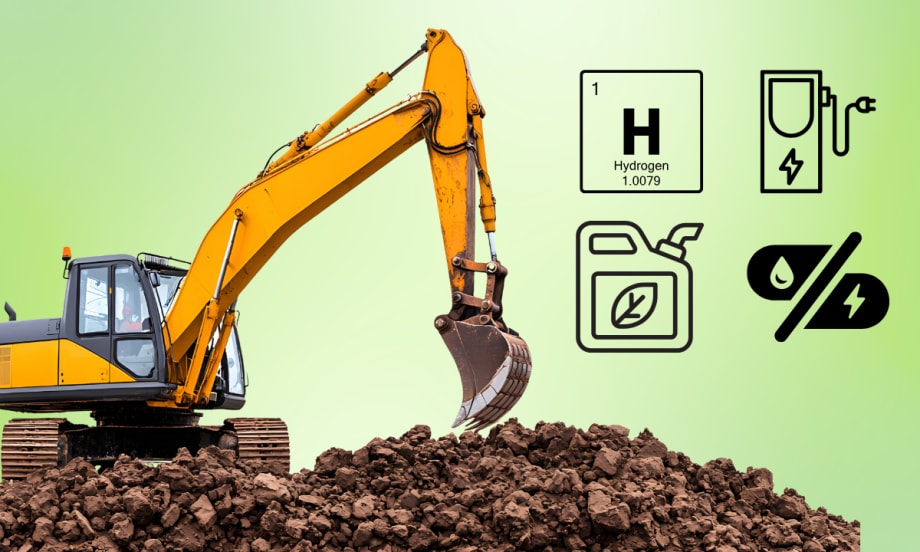
While battery-electric equipment is currently the leading zero-emission option, hydrogen is expected to play a significant role for heavier machinery and on-highway trucks. Manufacturers are testing fuel-cell prototypes, and transit pilot programs are providing early operational insights. Infrastructure development and cost reductions will be critical to hydrogen’s growth across off-road applications.
Planning for a Multi-Solution Transition
Hybrid, battery-electric, renewable fuels, and hydrogen technologies each serve different purposes. A successful transition for government fleets requires matching the right solution to the right job.
Key steps for agencies include:
Begin with renewable fuels and hybrid systems that fit existing operations.
Pilot electric equipment and use results to guide future investment.
Collaborate with manufacturers, dealers, and cooperative purchasing networks to plan for upcoming technologies and gather performance data.
Lowering emissions from off-road fleets won’t happen all at once. Incremental, practical changes made today will help build a cleaner, more resilient, and cost-effective future for public operations.
About the Author
Dr. Ray Gallant is Vice President of Sustainability and Productivity Services for Volvo Construction Equipment North America. He oversees product development, customer center operations, operator training programs, and other sales support activities.
Volvo CE plans to electrify 35% of its full product lineup by 2030 and reach net-zero value-chain greenhouse gas emissions by 2040. The company offers a broad selection of battery-electric machines, including compact electric models available through Sourcewell and the Canoe Procurement Group.




![Propper International HLX: Hybrid Lightweight Crossover [|CREDIT|]Photo: Propper International](https://assets.bobitstudios.com/image/upload/f_auto,q_auto,dpr_auto,c_fill,w_980,h_552/pm.propper-aug19hp_1759864252351_m5ncl6.jpg)