Red Government Fleet with star logo
MenuMENU
SearchSEARCH

Q&A with Kevin Myose: How Carsharing Saved San Joaquin County $1.7M

When San Joaquin County, Calif., set out to automate its motor pool, the fleet saw improved utilization, better inventory control, and $1.7 million in cost avoidance.

Thi Dao
Thi DaoFormer Executive Editor
Read Thi's Posts
August 17, 2018
Q&A with Kevin Myose: How Carsharing Saved San Joaquin County $1.7M

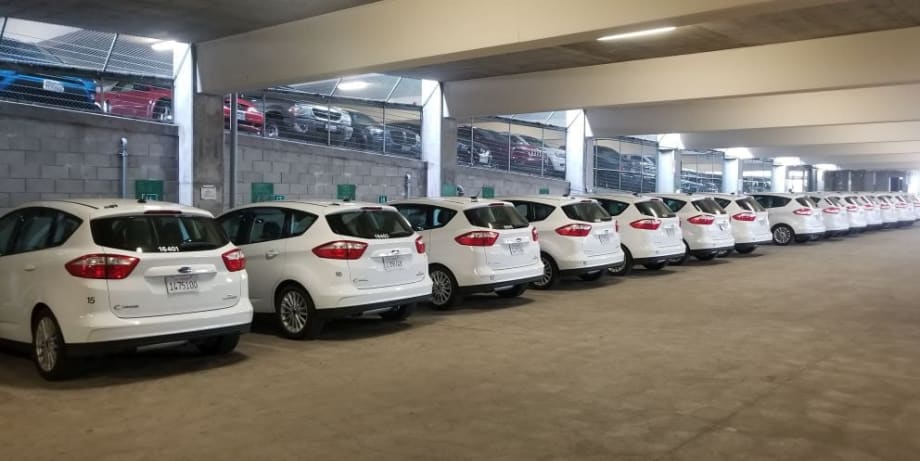
The majority of the compact and intermediate cars in the San Joaquin County, Calif., carsharing program are hybrids, and it's transitioning to plug-in hybrid electric vehicles.

Photo courtesy of San Joaquin County

3 min to read


In 2010, San Joaquin County, Calif., set out to automate its motor pool, turning it into a more effective carshare program. Kevin Myose, fleet manager, said the shift has allowed for improved utilization, better inventory control and reduced paperwork, and $1.7 million in cost avoidance. It now consists of an online reservation system, eight rental locations, and 240 vehicles, processing about 40,000 rentals annually.

With 20% of its fleet pooled, it has one of the highest municipal carsharing rates, according to its provider INVERS.

Myose will be speaking about carsharing at the Fleet Forward Conference on Oct. 9. He spoke with Government Fleet to provide a preview of why the program was started and the implementation process. The Q&A below was edited for length and clarity.

Q: Why did you automate the motor pool?

A: When we had the old motor pool system, cars were checked out once a day. It was a paper-based system. You couldn’t figure out inventory — you had to walk to the garage and look to see what cars were there. We’d get a rush of people who were worried about availability, and they’d check out a car and park it around the corner. Now you can see availability and condition of the vehicle. It’s more flexible and we can get up to four turns in a day. We get on average about twice the use out of the same vehicles.

Q: How do your rates work?

A: We have a fixed cost and a mileage cost. We’re constantly making sure it’s cost-effective. Every six months or so, I check prices against Uber, using a common route. One-way, Uber will beat me, costing $11. But for two ways, my car costs $17, so there is a cost advantage.

Q: What are some challenges you encountered in setting up the system?

Infrastructure was a challenge in the beginning, making sure it would work with our IT department. The rental system uses a lot of bandwidth, and we needed a reliable connection.

Selling it to our user departments was another challenge. We did some training and rolled out a pilot program with Public Works with six vehicles. We figured the engineers in the department were techie and would get it, and it worked out well. When we rolled it out to the larger user base, initially a lot of people were fretting about it. But after the first couple of months, we stopped having to do any training — they were teaching each other.

Q: What are the biggest advantages so far?

Higher utilization allowed us to reduce our fleet by 58 vehicles. That amounts to $1.7 million in replacement cost avoidance. And we’re definitely getting better use of our vehicles. People can’t hold inventory like they used to in the past.

Q: What’s next?

Right now, the rental rate varies based on mileage, but we have a class-based fixed rate system. We want to change that in the future. We’re also looking to get some equipment into the system, like dump trucks and backhoes. There’s a lot of stuff that’s seasonal, some of the stuff we don’t need as much. We can keep it, or sell it, or share it if two departments don’t need it at the same time.

Learn more about the benefits of carsharing, how to start or expand it in your own fleet, and how technology can improve customer mobility at the Fleet Forward Conference, which takes place Oct. 8-10 in San Francisco. Myose will be joining Alan Woodland from INVERS and Thi Dao from Government Fleet in a discussion, “Transforming the Motor Pool to a Shared Fleet – A Municipal Fleet Case Study,” on Oct. 9.

More Operations

Weekly cheat sheet reset button.
Operationsby Staff WriterFebruary 6, 2026

Is Fleet in a Reset Mode? | GovCast Shorts

On the go and want a snapshot of our top industry news? Check out Government Fleet's new video short of what's been happening.

Read More →
person at laptop taking survey.
Operationsby Staff WriterFebruary 6, 2026

Are You Paid Enough? Fleet Salary Study Open

Work Truck, Automotive Fleet, and Government Fleet have partnered to conduct a salary survey to determine the average salary for a fleet management position in commercial and public sector fleets.

Read More →
SponsoredFebruary 6, 2026

Hybrids: Electrification Without the Challenges

Hybrids bridge the gap between ICE vehicles and EVs, making them a smart choice for fleets that want to reduce emissions but aren’t ready to fully electrify. Hybrids, which are powered by internal combustion engines and electric motors, capture the benefits of electric power without the barriers many organizations find challenging.

Read More →
Ad Loading...
Image showing fleets dealing with budgets, data, and people for success.
Operationsby Nichole OsinskiFebruary 1, 2026

Fleet Performance Comes Down to People, Data, and Budgets

When it comes to the public sector, outcomes are usually driven by three areas fleet leaders can actually control, but it’s combining these into one operating model where operations see the most success.

Read More →
SponsoredFebruary 1, 2026

Why One Car Wash Wasn’t Enough For This Fleet

Limited wash locations can increase travel time, fuel costs, and admin work for fleets. Here’s how one government fleet expanded access and simplified operations.

Read More →
fleet image of check report and words cheat sheet.
Operationsby Staff WriterJanuary 30, 2026

Leading Fleets Lessons, Autonomous Policing, and the BEV Reality Check | The January Dispatch

To keep you in the loop, this episode is a quick reset on what mattered during the past month, from how to turn award season into a practical self-audit to what “leadership” looks like.

Read More →
Ad Loading...
image with the words read learn earn and a BBM star.
Operationsby News/Media ReleaseJanuary 29, 2026

Bobit Business Media Launches New Rewards Program for Industry Professionals

The new rewards initiative, B2X Rewards, is a gamified incentive program designed to increase engagement across BBM’s websites, eNewsletters, events, and TheFleetSource.com.

Read More →
Government Fleet's weekly cheat sheet for the end of January.
Operationsby Staff WriterJanuary 29, 2026

Cold Weather, EV Reality Checks, and What Fleet Leaders Are Doing Next | GovCast Shorts

On the go and want a snapshot of our top industry news? Check out Government Fleet's new video short of what's been happening.

Read More →
Image of man applying for leading fleets.
Operationsby Nichole OsinskiJanuary 28, 2026

Your Leading Fleets Application Can Do More Than Win an Award

Hear directly from this year's judges on what separates standout submissions and use their tips to submit a clearer, stronger application.

Read More →
Ad Loading...
A DASH electric bus parked on a city street in Alexandria, Virginia.
Operationsby News/Media ReleaseJanuary 27, 2026

City of Alexandria's DASH Partners with ABM to Support EV Bus Charging Infrastructure

DASH is expanding its electric bus operations in Alexandria, Va., with new in-route charging infrastructure.

Read More →