





At A Glance |
UCLA Transportation’s testing of Toyota fuel-cell vehicles provides a mutually beneficial experience:
|
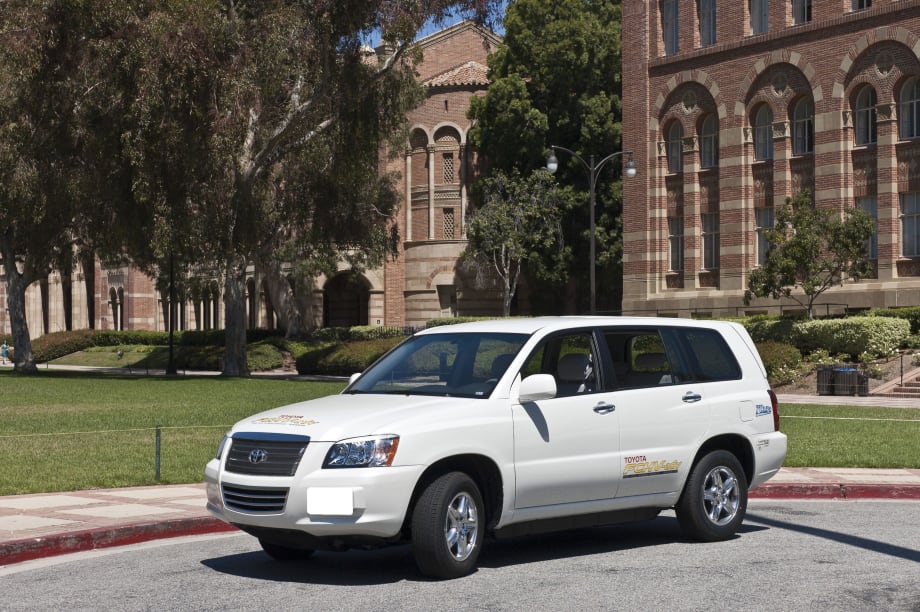
Your Los Angeles-area colleagues and friends would agree: Traffic is no fun in the City of Angels. TomTom’s 2012 North American Congestion Index found Los Angeles to have the highest congestion level. But while driving in the City can be a stressful affair, it is oftentimes a good place to test drive a vehicle — so say staff members at the Transportation department at the University of California, Los Angeles (UCLA). And so they pitched an idea to Toyota, asking to pilot hydrogen fuel-cell vehicles in carpool applications. Toyota agreed, providing the University with three FCHV-advanced Highlander-based vehicles for testing.
According to David Karwaski, senior associate director for Transportation Planning, Policy & Traffic Systems, the goal of the pilot was to set up as many wins as possible. For Toyota, the program allows the automaker to “pull telematics information from the vehicles routinely so they get actual real-world use data…through arguably the most arduous commuting environment in the world.”
For UCLA, the staff wanted to “work on our carpool program and try to increase participation in carpooling. Part of the idea was to get people in carpools and have them realize that this works fine, and when they’re no longer in the Toyota, they would continue to carpool together,” Karwaski said. In return, those participating in the program received a free ride.
Lastly, the pilot would be a boon to UCLA’s reputation as a “progressive research institution,” looking to the future of transportation, Karwaski said. With the South Coast Air Quality Management District (SCAQMD) looking at a combustion-free Los Angeles basin, Transportation Services staff wanted to help contribute to the research in alternative-fuel vehicles.
Finding Drivers Near Fueling Sources
Sherry Lewis, director of Fleet & Transit at UCLA, said the university fleet has long had a history in testing out new technologies, particularly with Toyota.
“We had a [Toyota] Prius in the fleet long before the general public knew what a Prius was. Our first Prius is still in the fleet today,” she said. She added that the UCLA fleet also currently operates four Camry vehicles that run on compressed natural gas (CNG), a vehicle Toyota eventually chose not to manufacture.
Choosing drivers depended on refueling station locations. UCLA Transportation staff mapped out home addresses of University staff, then drew buffer zones around those who lived near a fueling facility. They contacted those staff members to see if they wanted to participate in the program.
“We only have so many stations in the basin,” Karwaski said. The team chose to focus their two carpool groups in the South Bay, around a station in Torrance, 20 miles south of campus, near Toyota headquarters. The station there offered a higher compression fuel, resulting in a longer range per tank.
The third vehicle is used for training, demonstrations, and as a replacement for the other two in case one of the vehicles needs to be serviced, according to Matthew Hissom, senior transportation planner (and hydrogen vehicle project coordinator).
There are two types of fueling, staff explained. One is at 5,000 PSI, which provides a range of about 140 miles on the Toyota test vehicles; the other is 10,000 PSI, which provides a range of about 260 miles. And like other vehicles, fuel consumption depends on how drivers drive and what other vehicle features they’re using.
Toyota staff take drivers through a safety program for refueling, providing reading materials about the vehicles. Hydrogen fuel is currently available for free for research purposes.
Craig Scott, advanced technology vehicle manager at Toyota, said real-world testing results have been invaluable for the development team. “Tests with actual drivers, as opposed to our own test engineers, provide real-world feedback that helps us develop better retail products. We can’t anticipate all situations or all conditions, and having vehicles out in public hands gives us a richer data set,” he stated.
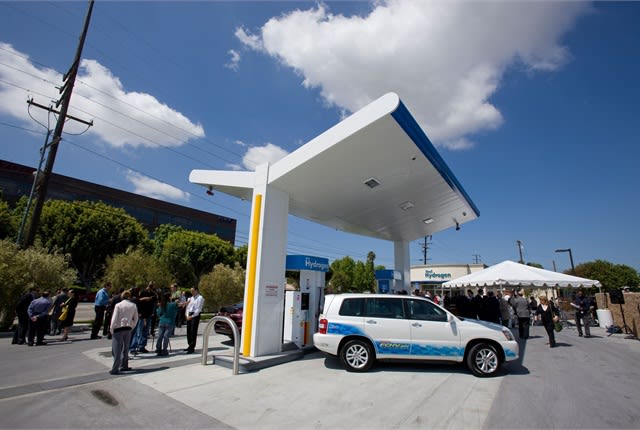
UCLA staff piloting the Toyota fuel-cell vehicles mainly use this hydrogen fueling station in Torrance, Calif. It opened in May 2011.
[PAGEBREAK]
Getting Driver Buy-in
Hissom said while some people choose not to carpool for various reasons, the perks of the hydrogen carpool program are sometimes enough to pique their interest: a free vehicle for use, free fuel, and a free parking permit. With individual driver permits alone coming in at $71 per month, that’s a big incentive. In exchange for their six-month commitment, participants would provide feedback on the vehicle. Drivers were hesitant once they found out the vehicle was hydrogen-powered but, “once they ride around in it a bit, they’re a lot more excited about the vehicle,” Hissom said.
Drivers also become educators, fielding questions about the technology from strangers, prompted by the graphics on the vehicles. Lewis said even though there are only three carpool hydrogen vehicles in the total rideshare fleet of 165 (vanpools), people know they exist.
“The more hydrogen vehicles we have, the more interest there will be,” in hydrogen, she said.
Test-Driving the Latest and Greatest
One of the perks of leading UCLA’s fleet is being able to test drive the latest and greatest vehicles on the road (and ones that aren’t on the road yet). And Lewis, with 22 years of experience in fleet, has been able to test a good number of vehicles.
“I’ve driven just about every type of alternative-fuel vehicle,” Lewis said. “The power of the [fuel cell] was a surprise....it’s amazing.” She added that the only concern she has, besides price, is the range when the vehicle is fueled at a lower PSI.
Karwaski said for UCLA, there are only soft costs associated with the pilot program, such as staff time. Toyota handles maintenance, which Lewis expects to be less than that of a gasoline-fueled car — more similar to an electric vehicle.
UCLA Transportation is looking to add more vehicles to its test fleet. If the university gets more vehicles, UCLA Transportation staff would focus on the Torrance station, for better fueling. Additionally, a new 10,000 PSI station in Newport Beach (about 50 miles away from the campus) recently opened, leading to the possibility of having a pilot group there.
And there is a station in the works on the campus itself. The Mobile Source Air Pollution Reduction Committee (MSRC) awarded a grant to the UCLA Chemical Engineering Department for the station. Still in the planning stage, the station will be available to the public.
What’s Next?
Government fleets are proving themselves to be early adopters of new technologies as they test new forms of alternative-fuel vehicles through purchases in small quantities and participate in projects such as this one. Lewis compares the hydrogen testing with UCLA’s investment in natural gas vehicles in the 1990s.
“It takes me back to when we started with CNG,” Lewis said of the hydrogen project. “It was a demo project; we got some money for it. We got a station, and things sort of developed.” Now, the UCLA fleet’s alternative fuel of choice is compressed natural gas, although Lewis said UCLA buys a little bit of everything.
While Lewis is enthusiastic about the development of fuel cell vehicles and said she sees an advantage of fuel cell over electric or plug-in electric vehicles, she does acknowledge competition on the development side from other forms of alternative fuel.
“I don’t think this technology will mature that fast,” as natural gas did, she said.
But once fuel cell vehicles are available for purchase, does Lewis see a fleet application for this vehicle? Sure, she said, if the price (or incentive) is right.
“It would depend on what the platform of the vehicle is,” Lewis said. “If we were to gain more vehicles of the current configuration, we can use that for…inspectors, field personnel who need to go off-site or carry materials; we have hospitals down in Santa Monica.” She can also see a use for the vehicle if it were a cargo van, and also in the motor pool since range has not been a problem. At this time, Toyota plans to have a fuel-cell sedan available for purchase by 2015. Other manufacturers, including Honda, Mercedes-Benz, and Hyundai already have vehicles available for lease in certain markets or have committed to releasing fuel cell vehicles in the next few years.
Fuel Cell Facts |
Below are some facts about fuel-cell vehicles.
1California Fuel Cell Partnership |


![Propper International HLX: Hybrid Lightweight Crossover [|CREDIT|]Photo: Propper International](https://assets.bobitstudios.com/image/upload/f_auto,q_auto,dpr_auto,c_fill,w_980,h_552/pm.propper-aug19hp_1759864252351_m5ncl6.jpg)