




At A Glance |
Fueling infrastructure for propane-autogas vehicles can be both centralized and dispersed:
|
When making the switch to alternative-fuel vehicles within a fleet, fueling infrastructure can be one of the most important considerations about fuel choice. For government fleet vehicles, which travel at varied ranges, both on- or off-site, refueling needs to be addressed. Two Department of Transportation fleets — the Department of Transportation for King County, Wash. (KCDOT) and the Indiana Department of Transportation (INDOT) — have added diverse on-site refueling methods for their fleet vehicles fueled by propane autogas. Infrastructure investment has provided both fleets confidence in their refueling abilities and overall savings in fuel costs.
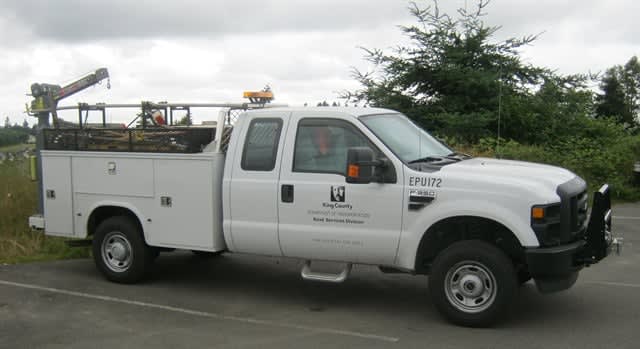
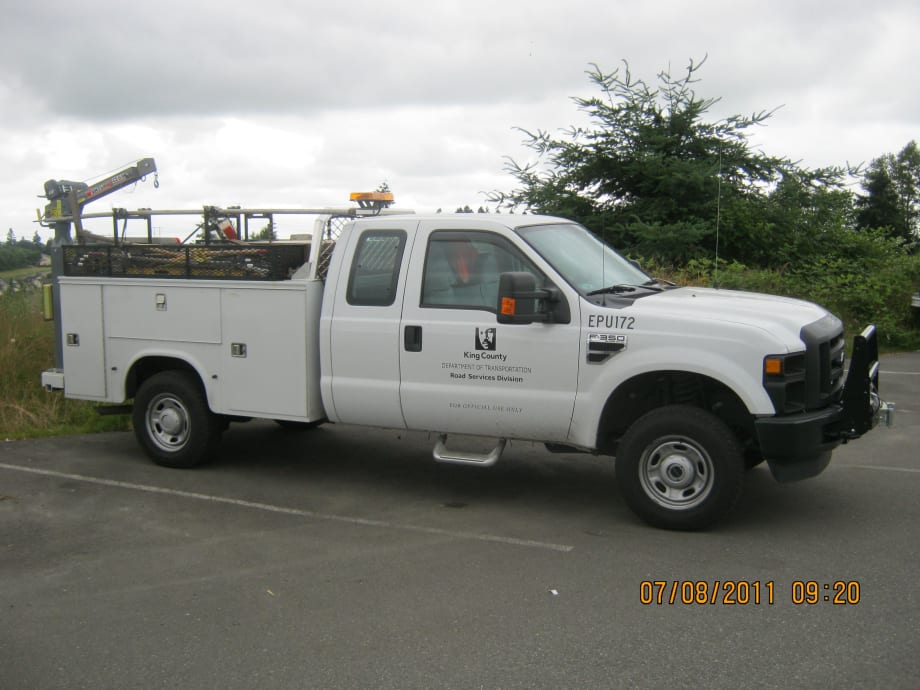
KCDOT has 20 fleet vehicles that run on propane autogas. These include Ford F-250 and F-350 work trucks and E-Series vans.
The KCDOT Fleet Division has 20 vehicles fueled by propane autogas, functioning in a wide variety of centralized applications. Crews from units responsible for sign and traffic signal repairs, electric and plumbing work, and road surveying are just a few that use the Ford F-250 and F-350 work trucks and Ford E-Series cargo and cutaway vans. KCDOT has renovated the on-site dispenser at its headquarters to allow for more efficient refueling.
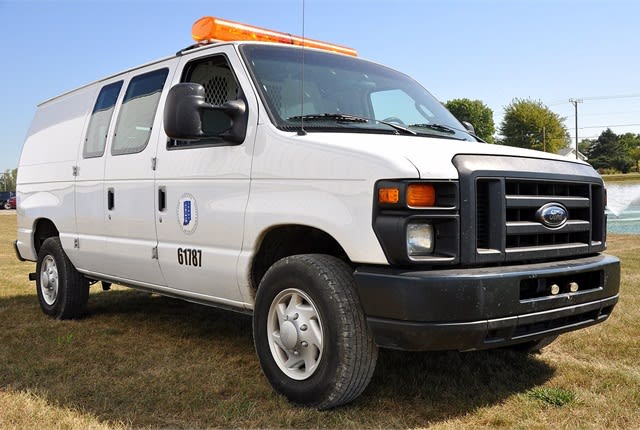
INDOT has converted nearly 600 of its light-duty vehicles to a bi-fuel system, using gasoline and propane autogas, for its fleet.
INDOT has converted nearly 600 of its light-duty vehicles to a bi-fuel system, using gasoline and propane autogas for its regional fleet. The vehicles are used statewide to transport highway maintenance crews, signal technicians, survey crews, and construction inspectors to job sites and projects. To allow for readily available refueling, INDOT installed refueling dispensers at 115 of its facilities across the state.
Building a Network of Refueling Sites
While these fleets have implemented refueling dispensers on very different scales, both have realized cost savings from installing an on-site refueling infrastructure.
Rising fuel costs were a factor for INDOT, which started exploring new ways to fuel its fleet of 2,300 light-duty trucks and vans in 2008 after gasoline prices increased.
“We were trying to figure out how to pay for fuel for the agency because we hadn’t budgeted enough for gasoline and diesel and didn’t want to pass that cost along to taxpayers,” said Mark Ratliff, INDOT’s director of agency results and forecasting.
INDOT implemented a comprehensive network of refueling sites and negotiated a fuel contract that saved significant taxpayer dollars; based on 18 months of data, INDOT estimates annual savings amount to $900,000 per year. INDOT’s 115 refueling sites were installed by both the agency and contracted personnel. The refueling locations are strategically located at INDOT facilities, such that nearly all state highways are within a 30-mile radius of a refueling site. These locations provide drivers with convenient accessibility.
Each refueling site has a 1,000-gallon tank accessible to drivers 24 hours a day; a fuel card issued to each driver provides dispenser access. The state has a sole-source contract with a propane-autogas provider to facilitate fuel deliveries.
[PAGEBREAK]
Providing Centralized Refueling
KCDOT has implemented propane-autogas refueling on a smaller scale for its centralized fleet. It upgraded the on-site dispenser at its headquarters to speed up the refueling process and installed a slightly larger storage tank.
The cost of installation of a fueling facility is comparable to that of a gasoline or diesel refueling station. Many propane providers across the country will even coordinate installation at no cost in return for a fueling contract, which was the case with the KCDOT.
The department provides fuel cards, enabling drivers to refuel at off-site commercial locations when needed. KCDOT has contracted with a local propane-autogas provider to schedule regular deliveries and supply emergency fuel service, if necessary.
“With propane autogas, we can easily expand or change our refueling strategy,” said Bob Toppen, KCDOT equipment manager, who noted the department is considering additional on-site refueling dispensers. “We’ve also noticed substantial fuel cost savings versus gasoline and diesel and are seeing a 50% reduction in fuel costs alone.”
Drivers in KCDOT and INDOT’s fleets have completed safety training sessions to learn the proper vehicle refueling procedures.
“Our fuel vendor provided initial training. We get ongoing training by the shop maintenance technicians, who also furnish information to drivers on fuel-related questions,” Toppen said.
About These Fleets | ||
King County (Wash.) DOT | Indiana DOT | |
Fleet size: | 2,600 units | 4,000 units |
Alternative-fuel or hybrid vehicles in the fleet: | 11% of the fleet consists of alternative-technology vehicles, including propane autogas, hybrid vehicles, compressed natural gas (CNG) vehicles, plug-in electric and all-electric cars, and ethanol-fueled vehicles. | More than 600 units run on propane autogas and/or compressed natural gas (CNG). |
Percentage of the total fleet running on propane autogas: | About 4% | Nearly 15% of the rolling fleet |
Propane autogas used by fleet vehicles in 2012: | 17,000 gallons | 575,000 gallons |
Both King County, Wash. and the Indiana DOT have invested in other forms of alternative fuel in addition to propane autogas.[PAGEBREAK]
Costs and Challenges to Implementation
Regulations in the State of Washington mandate the switch to alternative technology vehicles, biofuels, and electric vehicles. To comply with mandates while staying within budget, King County Fleet Administration sought grant funding as one of the strategies for paying down the extra cost of alternative-fuel vehicles, including it in its business plan submitted as part of its annual budget to County Council.
The fleet received federal Department of Transportation funding to completely offset the purchase of alternative-fuel vehicles through its partnership with Western Washington Clean Cities Coalition. However, Fleet Administration also studied the cost of conversions without grant finding and found “the conversion cost is more than recovered in fuel savings over gasoline within the life of the vehicle,” Toppen said. He stated that fewer exhaust emissions was the major factor in the decision process, and “green without loss of vehicle functionality” was a major factor for drivers.
As the County received updated propane infrastructure through the fuel supplier, the only cost it had to worry about was conversions.
For the INDOT’s propane-autogas fueling network, owned and maintained by the agency, the facilities did not come free of cost. It took nearly two years to implement the refueling network and 10 months for conversion of 226 light-duty vehicles. However, the INDOT received nearly $6.3 million in grant funding for alt-fuel projects as a sub-recipient to the Indiana Department of Energy, through the American Recovery and Reinvestment Act (ARRA). This grant paid for infrastructure installation as well as vehicle conversions.
What are the Costs & Cost Savings | ||
King County (Wash.) DOT | Indiana DOT | |
Vehicle conversion cost: | $10,900-$15,495 | $6,900 to $7,200 |
| None | $3.2 million |
Training time and cost: | Two days of vehicle system installation and repair training at no cost to King County provided by Roush CleanTech. Little training was necessary on the infrastructure, as staff was already familiar with the refueling process for propane autogas. | Maintenance and user training was included in the contact for the vehicle conversions and refueling infrastructure. Additional training was developed internally by existing staff with minimal cost. |
Fueling cost difference: | Propane autogas costs about 50% less than | Propane autogas has been 52% cheaper per gallon than gasoline. |
Reduced Maintenance, Same Performance
In addition to saving money through lower fuel prices, KCDOT may be saving money through reduced maintenance costs. Proponents claim that some advantages to propane autogas vehicles are reduced wear to engines and potentially longer engine life.
“We are studying the positive effects of propane autogas and how we can further reduce maintenance costs,” Toppen said. “Our technicians have completely accepted the propane-autogas-fueled vehicles, and there are no concerns from them on maintenance or repairs. We are looking into extending service intervals.”
Both fleets are also closely monitoring vehicles’ performance characteristics. INDOT has experienced a high level of vehicle performance, which has been confirmed by measuring torque and horsepower prior to and following conversion. The agency is establishing the necessary components to sustain the program for many years to come. More than 60 of its 200 repair technicians are trained in proper maintenance, repair, and diagnostics of bi-fuel propane autogas systems.
“By saving money on fuel, INDOT is able to further invest in its fleet and highway maintenance,” said Steve McAvoy, INDOT’s fleet and facilities director. “This makes INDOT’s management of State highways safer for our workers and motorists.”
About the Author
Mike Taylor is the director of autogas business development for the Propane Education & Research Council.


![Propper International HLX: Hybrid Lightweight Crossover [|CREDIT|]Photo: Propper International](https://assets.bobitstudios.com/image/upload/f_auto,q_auto,dpr_auto,c_fill,w_980,h_552/pm.propper-aug19hp_1759864252351_m5ncl6.jpg)