





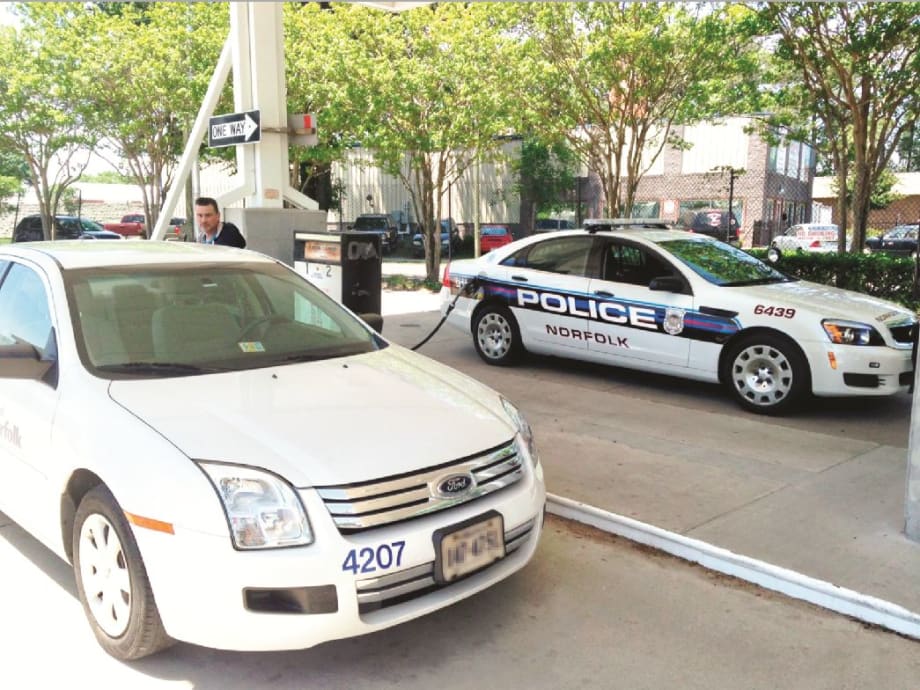
The City of Norfolk, Va., owns two fueling stations and supplements fuel purchases at retail sites
using a fuel card. Photo courtesy of City of Norfolk
Fuel has long been one of the highest operating expenses for fleets; obviously the larger the fleet, the more fuel those vehicles will consume. So when gasoline prices began to drop last July, it was a much-needed break for fleets across the country. Several fleets were able to realize significant savings as a result of lower fuel prices.
Price Drops Lead to Short-Term Savings
From July 2014 to January 2015, gasoline prices continued to offer motorists across the country (and their wallets) a temporary relief from the $4-per-gallon price range. Week to week, prices slowly decreased by several cents; by January, the U.S. Energy Information Administration (EIA) reported a price difference of more than $1.60 since July (from $3.68 to $2.04).
Fleets were able to capitalize on these temporary lows, with a number of them saving anywhere from a couple hundred thousand to a couple million dollars during that time period. Some of those with locked in fuel prices were unable to see these savings, but for them, budget stability was a solution they embraced.
Those making headlines across the country for saving money in fuel costs included:
City of Corpus Christi, Texas — uses about 1.65 million gallons of gasoline a year, costing about $5.1 million. In January, it reported $200,000 in savings.
City of Augusta, Ga. —uses 800,000 gallons of fuel per year for its fleet, anticipated spending $2.8 million but actually saved more than $100,000 per month in fuel costs.
City of Madison, Wis. — reduced its fuel budget by $200,000 from the original $3.63 million estimated during the summer. Fleet drivers use 1.1 million gallons of gasoline and diesel.
Government Fleet caught up with several other fleets to find out their experience with these fluctuating fuel prices.
Less Fuel Consumption Leads to Lower Fuel Budget
One such fleet that has seen a significant fuel cost reduction is the City of Jacksonville, Fla. With roughly 3,700 units in its fleet — ranging from police cars to fire engines, off-road equipment, and motorcycles — the short-lived shrinking gasoline prices have added up to more than a pretty penny in savings. Its $21.2 million fuel budget is approximately $2 million less than last year’s budget, according to Karim Kurji, chief of fleet management.
The bulk of the fleet is made up of police vehicles, about 1,200 of which are marked units, which are available 24 hours a day and must fuel up daily.
According to Kurji, Sheriff’s Office vehicles consume the most fuel just due to sheer volume. “Our city is 875 square miles, so we cover a lot of miles. We’re actually the biggest city landwise in 48 states, not counting Alaska and Hawaii,” he said.
The city owns nine fueling stations throughout Jacksonville. Pumps are accessed through an operator/vehicle card that tracks mileage and turns on the pump.
Fuel price volatility has presented some challenges for Kurji and his team when planning the fuel budget. “The unknowns are what happens around the world. Fuel prices can go up based on Mother Nature or world events. You never know and the best you do is with the numbers we have,” he explained.
Jacksonville’s fuel budget gets set Oct. 1 and stays that way unless the City Council changes it. “Right now we’re still at $21.2 million. This year, it’s about 56% of the overall fleet budget, but it varies between 56-60% year in year out, so fuel is always our biggest line item on our budget,” Kurji said.
The fuel budget is based on actual gallons used and fleet size. For pricing, the City uses U.S. Department of Energy fuel forecast numbers.
Kurji also pointed out that while the fleet may be under budget at this time for fuel spending, he and his team are anticipating spending more in the upcoming summer months, when the city historically spends more on fuel due to hurricane season and the hot weather.
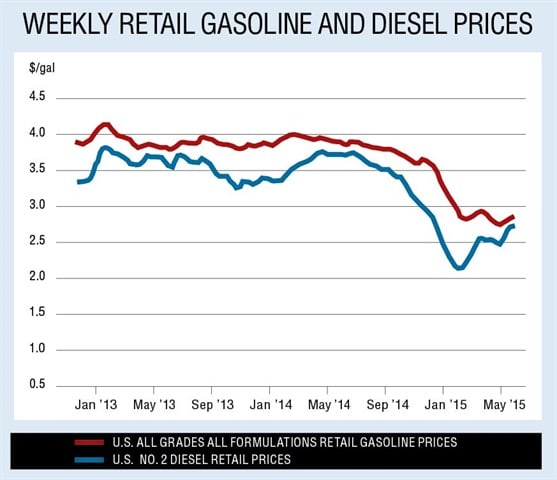
Data from the U.S. Energy Information Administration shows that fuel prices fell between July 2014 and January 2015.
“Our first six months, we use 40-42% of our budget. The second half of our year is when we have higher usage of our fuel because of summer months when vehicles are using air conditioning,” he explained.
Kurji said it may still be premature to consider real savings at this point. “We’re very cautious because one third of our fiscal year is during hurricane season [June 1-Sept. 30], so I don’t get very excited until Sept. 30. From last week to this week [April 17-24], fuel has gone up about 17 cents. So historically we are under budget the first part of the year and then it catches up the second part of the year.”
Kurji says he’s happy to be able to help save taxpayers money where the division can. Being under budget at the end of the fiscal year means the excess money can get rolled up into the city’s operating reserves.
Locking in Lower Fuel Prices
The City of Norfolk, Va., has also been able to take advantage of lower fuel prices. The city locks in low prices whenever it can and is saving nearly $2 million in fuel costs due to locking in prices at the right time.
The fleet operates approximately 2,100 units and consumes 1.2 million gallons of diesel and 850,000 gallons of unleaded each year. Facundo Tassara, fleet manager, said there are only two city-owned fueling stations for the entire city (located relatively close to one another) so the fleet must rely on retail sites on the opposite end of town. Because of this, locking in fuel prices is a good option.
Norfolk has a contract with Parker Oil to fuel up at these various fueling sites. Parker Oil negotiates with retail gas stations strategically placed in the city in areas where the fleet doesn’t have any. Whether the fuel is purchased at city or retail sites, price locking has helped save the city money.
Tassara explained that the fiscal year and pre-negotiated fuel prices both end in June. Before June, he asks the fuel vendor for a new fixed-price quote for the city’s future fuel needs. In March this year, knowing fuel prices were on the rise, Tassara began asking for a new quote for the following fiscal year. “By negotiating my contract now, prices are a lot lower,” he explained.
By locking in a base price for gasoline and diesel fuel in March, the City of Norfolk ended up with a contract that was about $1.7 million less than it paid in FY-2015. What’s more, by paying retail prices for about a month and delaying locking in a price until fuel stabilized last year (following conflict in the Middle East) he was able to save $180,000 in fuel costs during FY-2015 from the prior year, resulting in nearly $1.9 million in savings over two years.
The contract allows city employees to fuel up at both city and retail fueling sites. The difference in price between a retail site and a city fueling site is usually about 3 or 4 cents per gallon, Tassara said. “This Parker Oil fuel card will identify where we purchased it, and then it’ll bill us the markup accordingly. But it’s a fixed price. The only thing that fluctuates is that markup based on where we purchased our fuel.”
If at the end of the fiscal year, the fleet has used less fuel, then it is tied into buying the remaining amount in that contract at that price.
“At times it may or may not benefit us. If fuel goes down…it doesn’t really benefit us. But on the flip side, if we consume more fuel [than we expected], then we’re going to be stuck paying market...and market may be more or may be less when we exceed the amount,” he said. Luckily, that hasn’t been an issue yet.
“It’s actually worked out for us where the contract came to an end in the summer months, when we had to consume what was left. The good news was that our fixed price was lower than the retail price at the time,” he noted.
A high water table makes it expensive to install additional city fueling facilities — Tassara would prefer the retail sites take that risk and maintenance responsibility. He also added, “Where some people have a negotiated price for fuel, they still have the upkeep of their infrastructure and everything that goes along with that. We only have that for two sites in a city that is really large.”






![Propper International HLX: Hybrid Lightweight Crossover [|CREDIT|]Photo: Propper International](https://assets.bobitstudios.com/image/upload/f_auto,q_auto,dpr_auto,c_fill,w_980,h_552/pm.propper-aug19hp_1759864252351_m5ncl6.jpg)