




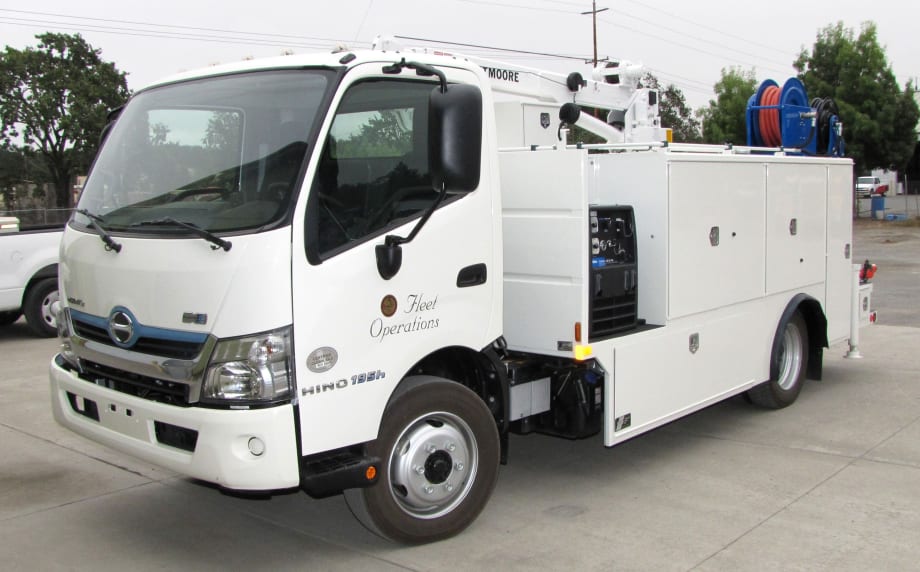
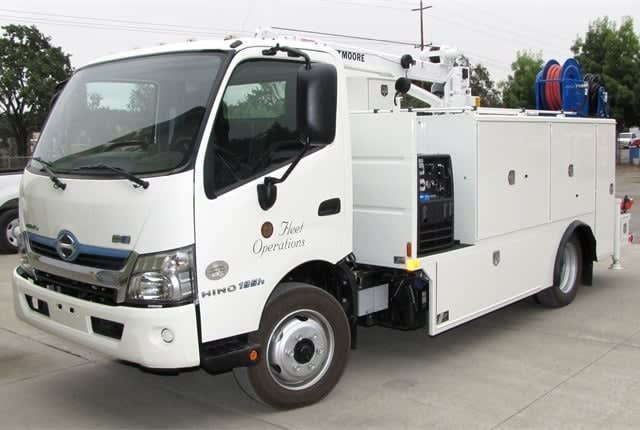
The 2014 Hino 195H hybrid service truck utilizes hybrid electric drive technology to reduce fuel consumption by up to 30% over that of a conventionally powered truck. Photo courtesy of Sonoma County
The Sonoma County (Calif.) Fleet Operations Division took delivery of its first hybrid electric (HEV) mechanic’s service truck to support its field service program in September. The 2014 Hino 195H hybrid utilizes hybrid electric drive technology to reduce fuel consumption by up to 30% over that of a conventionally powered truck. The addition to the service fleet is expected to reduce customers’ vehicle maintenance costs.
The addition of the Hino will bring the total number of hybrid and electric vehicles, including medium- and heavy-duty vehicles, to 293 units, said David Worthington, fleet manager. The county’s fleet of hybrid and all-electric vehicles has reduced fuel consumption by more than 166,558 gallons and the resultant CO2 emissions by 1,815 tons.
Working Out the Details
Members of the fleet technical team spent nearly a year working on all the details to ensure the delivered truck would immediately meet the fleet’s operational needs. One of the biggest challenges was designing the mechanic service body to integrate with the hybrid components without compromising serviceability. Worthington said the transmission service fill point was a particularly difficult challenge that necessitated the service body to be set back away from the cab by 12.5 inches, which then created other challenges with the overall design and body compartment dimensions. A local company manufactured the service body and met all the demands of the custom configuration created by the hybrid application.
The cab-over-engine (COE) design allows the truck’s wheelbase to be shorter than in a conventional arrangement and gives comparatively unobstructed access to the engine. The cost of maintaining medium-duty trucks that are based on standard cab and engine bay dimensions has been increasing as more technology is installed into a limited area of space, Worthington said. The ability to access components in the engine bay for maintenance and repairs is becoming more difficult, and a COE helps the fleet resolve this issue.
New Truck Contributes to Field Service
Fleet Operations currently uses three field service trucks: a Ford F-350 super-duty, a Ford F-450, and a Peterbilt 335. The addition of the Hino hybrid service truck will increase the division’s field service capabilities by 25% and reduce transport costs for customers by performing more work in the field.
In 2013, Fleet Operations conducted an analysis of its field service program and determined that an increase in field service calls of 35% from 2012 to 2013 saved customers $1,426 in sublet vendor towing and transport costs and more than 2,200 hours of customer staff time to drop off and pick up vehicles and equipment. The staff time savings included factoring in “windshield” time spent by technicians traveling to and from the maintenance facility. Worthington calculated that the reduction of customer staff time necessary to manage the transport of vehicles represents a total labor cost of between $66,000 and $84,000.
Fleet Operations worked with the vendor to take advantage of the California Hybrid and Zero-Emission Truck and Bus Voucher Incentive Project (HVIP) to reduce the overall acquisition cost of the truck by $23,000. The cost differential between a conventionally powered diesel model and the hybrid unit was $12,087, which made the commitment to hybrid technology easier to justify, Worthington explained.
“The addition of this truck to the fleet continues the county’s commitment to technologies that provide a higher level of performance in fuel economy and emissions reductions while still meeting the operational needs of the technical team and customers,” he said. “The fleet plans to integrate more of this type of technology into its heavy equipment fleet to lower operational costs while meeting sustainability goals.”




![Propper International HLX: Hybrid Lightweight Crossover [|CREDIT|]Photo: Propper International](https://assets.bobitstudios.com/image/upload/f_auto,q_auto,dpr_auto,c_fill,w_980,h_552/pm.propper-aug19hp_1759864252351_m5ncl6.jpg)