




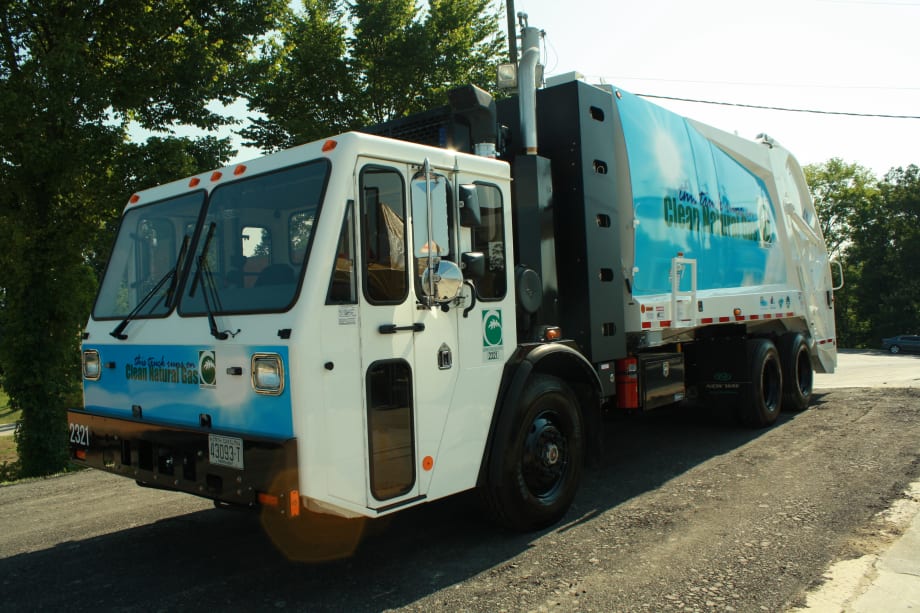
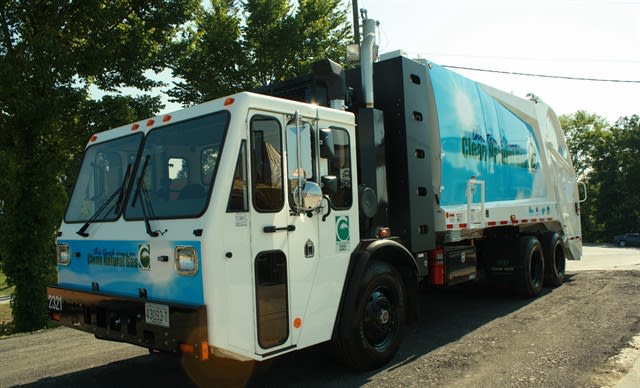
The City purchased the two CNG trucks with grant funding. Photo courtesy of the City of Greensboro.
GREENSBORO, NC - The City of Greensboro, N.C., celebrated the opening of a compressed natural gas (CNG) fueling station and unveiled two CNG recycling trucks on June 29. GF spoke to Steve Simpson, former fleet manager and current management consultant for the City, about developing the CNG station and calculating return on investment.
The total cost of the slow-fill CNG fueling station is approximately $200,000; most of this is paid for with American Recovery and Reinvestment Act (ARRA) funding from the U.S. Department of Energy, in a project led by the Triangle J Council of Governments. Simpson said at this time, the City expects to spend $20,000 of its own funds for the station.
The station currently has two filling posts, with the capacity to expand to 12 if the City decides to expand its CNG fleet.
“The legwork’s already there; we’ve got underground conduit and things of that nature. It’s just a matter of mounting the posts with hoses on it so they can hook additional trucks to them,” Simpson said.

The station is mostly paid for by American Recovery and Reinvestment Act (ARRA) funding from the U.S. Department of Energy. Photo courtesy of the City of Greensboro.
Current fill time is three hours for two vehicles. The number of vehicles fueling at the station will affect the time it takes to fill up, but Simpson said he spec’ed the facility to fill 12 vehicles simultaneously to capacity in eight hours, during downtime for Solid Waste trucks.
Additionally, the CNG station also has the capability of expanding and migrating to a fast-fill station if the need arises.
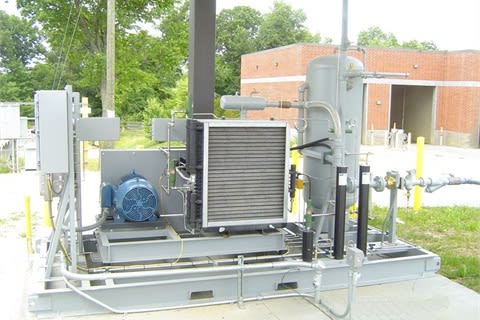
Total cost of the slow-fill CNG fueling station is $200,000. Photo courtesy of the City of Greensboro.
The City went with the slow-fill station because it was more economical to do so, but also as a way to test out CNG.
“We basically wanted to ensure there was a cost savings, that the trucks were going to be reliable,” Simpson said.
The City purchased two CNG rear loaders for the Field Operations Department, Solid Waste Division, used for recycling. The vehicles, which were delivered already converted for CNG use, are from Crane Carrier Corporation and have a Cummins Westport engine.
The return-on-investment projection for the trucks is about three years; the incremental cost for a CNG Solid Waste vehicle is just under $30,000, and the City projects fuel savings of $10,000 annually per truck, Simpson said. He calculated these projections using the City’s current CNG cost of 95 cents per diesel gallon equivalent and $3.19 per gallon of diesel, based on the yearly average. Not counting the ROI savings from the first three years, the City still expects to reduce fuel costs by an additional $55,000 over the lifecycle of the rear loader (eight to nine years).
Simpson said the City does plan to expand the CNG fleet. However, he added that the CNG trucks have been in service only a few months, and the City needs between six months and one year of usage to evaluate results. He also reported that so far, there are no problems with the trucks.
The gas company, Piedmont Natural Gas, has a fast-fill CNG station approximately three miles from the maintenance facility. “If our station goes down, we have access. Now the fuel costs a little more…but we do have access to that station if we need it,” Simpson said.
Simpson was the Greensboro fleet manager until he retired in November 2011. However, he had been working on building a CNG station for the City for more than a year, and the City retained him as a management consultant for the project. Jerry Gunter is the current fleet manager.
By Thi Dao




![Propper International HLX: Hybrid Lightweight Crossover [|CREDIT|]Photo: Propper International](https://assets.bobitstudios.com/image/upload/f_auto,q_auto,dpr_auto,c_fill,w_980,h_552/pm.propper-aug19hp_1759864252351_m5ncl6.jpg)