Three years ago, I penned an article published here and titled, "Flavor of the Decade – The Current State of Play," where these questions were offered: “What if the automobile market becomes too populated with BEV’s …that the market dries up?” and “What if the general public fails to accept an expensive BEV that, even years from now, will only travel 300 miles, or less…?”.
While we prepare for the as yet unknowns associated with a new administration, the answers to these and to other BEV unknowns are still unclear. The future of electricity as a primary motive source has become more like a character from “The Wiz” as we are advised to pay no attention to the “man” behind the curtain.
Planning for What's Ahead in Fleet
How can we, as active participants in the automotive sector, plan for a BEV future which is now less clear, characterized by multiple start-up failures, a Wild West of charger deployment, and features legacy OEM’s stepping away from their own ‘electro-euphoria” strategies as the BEV transition momentum slows to a crawl.
All this despite the sunset of the current administration from which billions of BEV and charger support commitment dollars have flowed at a level heretofore unseen in history and yet, the state of electrified transportation remains staggered by the weight of its own perception.
An argument can be made that this is the “calm” before the next phase of ambitious growth, but that argument falls flat when the market continues to falter and may suffer further challenges with a new party in power in Washington which has seemed less enamored with BEVs.
The future of that avalanche of funding is surely in some jeopardy after January 20. Determining just how much public funding (Federal, State & Local) has been spent and committed for the future in supporting BEV manufacturers, battery production, and infrastructure deployment in the US, while difficult to quantify, is easily enough to write a check to each citizen for $1 million!
Procurement Success Over the Long Term
From 1900 to 1940, as the nation was transitioning away from BEV’s, hundreds of automobile manufacturers failed. There is no record then of government supporting the manufacture of ICE vehicles nor the deployment of gas stations. The market did what the market is expected to do and yes, the market has clearly spoken again.
Is there a lesson from a decade ago when the Federal government and taxpayers were stuck with the loss of $139 Million for Fisker Automotive’s failure which itself was preceded by the larger taxpayer loss of $528 Million for the Solyndra solar panel company failure?
What evidence exists to validate the success of Federal “investments” in the private sector beyond perhaps the COVID bailouts of General Motors and Chrysler or the $465M loan to Tesla which was actually paid back early?
Unlike private sector companies whose success is measured in quarter-to-quarter performance, fleet buyers and in particular government fleet buyers, measure procurement success over the long term, total cost of ownership life cycles that presuppose certain criteria.
The business case associated with investments in BEVs and infrastructure future values is now uncertain enough to cause the variables in the TCO equation to be speculative at best and dangerous at worst.
While the business case for BEV’s in government service is stronger than that of any other commercial application, an even stronger business case for government fleets is likely the hybrid electric (HEV) vehicle alternative for which the infrastructure already exists, resale is less uncertain, employee acceptance is high, and the vehicle price is more attractive. My Rav4 gets a quite satisfying 41 mpg.
The State of Play in the New Year
Even as research for this article was being compiled, another BEV start-up, Canoo, ceased production and will likely go the way of Lordstown, Foxconn, Fisker, Electric Last Mile, Bright Automotive, and Coda Automotive in the US.
The futures of Rivian, Lucid, VinFast and Nikola are all in various stages of uncertainty and it seems more likely than not they too will join the failure list sometime in the new year.
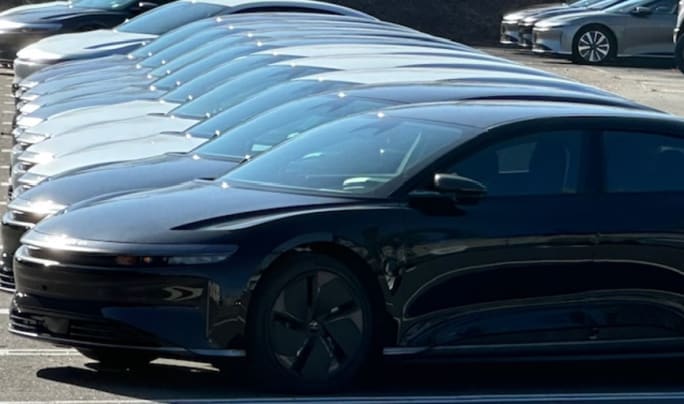
A photo of the Atlanta Lucid dealer’s year-end inventory totaling over 50 units.
Photo: Bob Stanton
So, what is the current state of play in the BEV transition in the new year? Here are some clues:
A June ’24 presentation by McKinsey & Company indicated that 46% of EV owners are very likely to switch back to conventional ICE vehicles.
In that same presentation, 34 percent of EV owners voiced concern about high ownership costs.
The Federal government and some states have pushed forward with aggressive EV mandates that many in the industry view as impractical as many of the ramifications are not fully understood such as a lack of infrastructure maturity and its impact on the electric grid.
According to Applied Energy, if BEV adoption reaches 50 percent in the Western U.S., current charging habits would necessitate 5.4 gigawatts of energy storage – the equivalent of five large nuclear reactors.
The second-hand market was expected to be a key element in boosting BEV adoption. However, price cuts from BEV manufacturers and higher-than-expected repair costs have caused used BEV prices to crater. Further, the consumer desire for technological improvement and the lack of chargers continue to burden prices for used, older BEVs.
Ford, GM, Hyundai, Kia and Toyota are gladly expanding their hybrid offerings as the market trends shift. Unlike BEVs, hybrids are more profitable to sell.
The Biden administration relaxed tailpipe emissions in recognition that market softening in EV acquisition rates will compel acceptance of a longer EV transition timeline than previously forecast or expected.
The average price of a 2024 BEV was $55,167, a slight decrease from 2023, but still too high for many consumers.
The Society of Automotive Engineers (SAE) has been uncharacteristically absent as a leading force in the establishment of EV standards. In 2024 however, SAE has committed to the establishment of a “Certificate Trust List Requirements”. If successful, it will basically be a notebook for automakers, charging companies and equipment suppliers who will have to meet certain technical and safety standards for plug and charge.
Range anxiety continues to plague BEV adoption. For instance, a 2024 test by What Car magazine revealed that the official published BEV ranges offered by OEMs over-estimates their real-life range by around 1/3. Vehicles in their study were driven around a test track in the UK until they ran of juice.
State budgets nationwide are grappling with expected highway fuel tax shortfalls caused by the growth of EVs and HEVs resulting in fewer gallons pumped and lower fuel tax revenues. It’s likely states will adopt alternative taxation methods for vehicle owners to recover this revenue critical for maintaining roadways now featuring higher wear characteristics due to the heavier weight of BEVs.
Charger deployment promoted by the Infrastructure Act has been tepid at best. According to information published by ING, despite the billions committed by the IIJA, charger deployment has been stymied by contract performance requirements and a lack of expertise from state and local governments in tapping into IIJA funding. The charging industry itself is challenged by low profitability partly due to mild electricity demand and low utilization and BEV adoption rates.
CARB, anticipating blowback from the new administration, dropped their requested EPA waiver to set stricter emissions rules for heavy trucks and locomotives. CARB’s rule banning the sale of new gas-powered cars by 2035 remains in place…for now.
Clearly, the current state of BEV adoption is disappointing, lacks consistent leadership, and has resulted in a convoluted and confusing lack of direction, consistency, mandate interpretation and poor consumer acceptance.
The marketplace recognizes these factors as indications of an industry that may not be ready for prime time after all. Regardless of the historic level of government funding, consumers have “voted with their feet” on the showroom floors resulting in an EV adoption rate tepid enough to worry every auto manufacturer, everywhere but in China.
As convoluted as the current state of play is today, the situation may resolve and gain clarity under the next administration, but it could just as easily become even more complex.
Strategies for Fleets Planning for the Future
So, how should a government fleet, a local government, and public sector procurement approach asset acquisition under these challenging and uncertain circumstances? As always, the implications of your decisions must be accepted, executed, justified and managed over the long-term.
With eyes on the future, consider these strategies as you seek to satisfy your constituents while maintaining stewardship of their trust:
Environmental initiatives must be shared among all departments. While it is convenient to demonstrate environmental consciousness via fleet electrification, there are many overlooked steps that other departments can and should adopt to ensure the entire entity is on board and has ownership in environment initiatives and carbon neutrality.
A closer look at such enhancements through LEED certification, solar panels, LED lighting fixtures, optimizing HVAC systems while not as sexy as electric vehicles, can have lasting environmental value.
Hybrids (HEVs) offer an efficient and less expensive alternative to BEV’s. Hybrids offer double or triple the mpg of conventional ICE vehicles without the need for expensive charging infrastructure or the purchase of vehicles costing $50,000 plus. For instance, a hybrid Maverick costs $1500 more than a conventional one.
Owners of the hybrid version typically reach the break-even point after only 40,000 miles and with no charging infrastructure cost required. For government fleets, their refueling infrastructure is already in place.
Downsize both the size of your fleet inventory and the size/model of vehicles operated. Most government fleets have more vehicles than they need. Further, many government departments operate larger vehicles than are necessary for their mission profiles.
These actions are often hard sells but most fleet consultants can study your present fleet and recommend objective solutions that make sense, save money with little operational disruption.
Adopt proven fuel conservation practices that work. Such steps include Idle Monitoring and Control; Speed Limitation and Control; Targeted MPG employee incentives and rewards. These steps work, require little investment and if managed well, assure employee buy-in and participation. Most governments utilize telematic solutions that are geared and designed just for this purpose.
Adopt or implement an internal car share vehicle pool. Many governments now utilize services such as Uber or Lyft or vehicle pooling to supplement their vehicle inventories. In either case, both strategies function to satisfy their fleet’s primary mission which is to operate their fleet with the fewest number of vehicles possible.
The current state of play and the uncertainty of the future state of BEV adoption and support should be worrisome to most stakeholders, which certainly includes public sector fleets. If you have not yet made the jump to BEVs, stay tuned and remain cautious.
This is a minefield of conflicting and as yet underdeveloped intentions which may become even more confusing in the coming months. Listening to the tempered voice of the well-informed and reasoned fleet manager may become a government entity’s best strategy ever.
This article was authored and edited according to Government Fleet editorial standards and style. Opinions expressed may not reflect that of GF.