Red Government Fleet with star logo
MenuMENU
SearchSEARCH

Set Your Own Vendor Fuel Surcharges

There is little doubt, given recent fuel price escalation, that surcharges either are or will be back. Here’s an idea: Why don’t you set and control them?

by Bob Stanton
March 11, 2022
Set Your Own Vendor Fuel Surcharges


2 min to read


We thought fuel surcharges, those pesky vendor add-ons, were a thing of the past. That past was the summer of 2008, the last time we experienced a record national average fuel price per gallon. There is little doubt, given recent fuel price escalation, that surcharges either are or will be back.

Honestly, fuel surcharges are a fair and equitable way for our service providers to offset their increased fuel costs. Some governments may prefer to hold vendors accountable for their agreed- upon rates but to be fair, their rates were set when fuel prices were “reasonable.” As good stewards and with our desire to treat the marketplace fairly, fuel surcharges should be allowed, regardless of contract languages or purchase order rate constraints. The question for us is how we will monitor and control them.

Here’s an idea: Why don’t you set and control them? In the summer of 2008, in Polk County, Florida, we took several steps to mitigate fuel prices that had exceeded $4.00/gallon for the first time in history. Among those steps was notifying our towing, parts delivery, on-site service providers, and transport companies that the county (fleet management) would set the surcharge rate on a per-mile basis and add that amount to their invoices prior to payment. Using this method, we controlled the surcharges, we avoided the often-arbitrary assessments vendors would add, and vendors actually appreciated our effort.

Our method used the simple spreadsheet below. We set three categories of vehicles: heavy truck/transport/wrecker/Landoll; medium-duty flatbed roll-off or rear drag wrecker; and compact car/pickup. We used a base average miles per gallon for each category, the base fuel price/gallon (price at the end of January 2022 for instance in today’s world), and the current price/gallon when the services were rendered. Our spreadsheet calculated the increased fuel cost to our vendors in a cost/mile calculation. Using their invoices, on which mileage was reported, we added the additional fuel cost as calculated by our spreadsheet to their payments. Our finance department appreciated this method as well because it was well justified and documented.
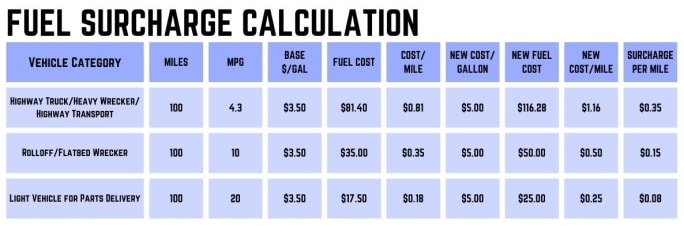
The only modification necessary is shown in the column for the new cost/gallon, where staff can enter today’s fuel cost/gallon using OPIS, the local 7-11, or whatever source seems to reflect the current market price in your area.

This is an easy step that will pay dividends in vendor relationships, give you more control over your costs, protect against arbitrary price hikes, and is easily justifiable both for your accounting and for the marketplace.

About the Author: Bob Stanton is a consultant for Stanton Fleet Consultants, based in Cumming, Georgia. He previously served as a municipal fleet manager for 25 years and prior to that worked in the private fleet industry. He can be reached at victorybob@gmail.com.

Subscribe to Our Newsletter

More Blog Posts

Fleet Voicesby Staff WriterNovember 20, 2025

How Electric Vehicles as a Service Could Reshape Public Fleets

How the EV model can address concerns about meeting state mandates, cost, emissions and range anxiety.

Read More →
Fleet Voicesby Rachael PlantNovember 19, 2025

14 Metrics Government Fleets Should Track

The metrics government fleets should track to get a full understanding of their fleet operation.

Read More →
Fleet Voicesby Facundo TassaraNovember 12, 2025

Pick One: Hire a Technician or a Data Analyst

Short on techs and drowning in data, which single hire moves your fleet farther—a technician or a data analyst—and how does AI change the calculus?

Read More →
Ad Loading...
Fleet Voicesby James "Jimmy" JohnstonNovember 10, 2025

Why Refuse Truck Tech Must Serve the Operator

Ride along on a pre-dawn refuse route to see how operator-first, integrated safety technology turns split-second risk into preventable events and why purpose-built trucks are the next step in fleet safety.

Read More →
Fleet Voicesby Rachael PlantOctober 31, 2025

7 Tips for Smarter Fleet Management

The potential to manage your fleet effectively while ensuring the safety of both employees and the community can often go untapped, but there are certain habits you can adopt to get to that point.

Read More →
Fleet Voicesby Jason AlbericiOctober 3, 2025

Why Benefits Are Key for State and Local Fleets Looking to Win Federal Talent

State and local agencies have a unique chance to recruit skilled federal employees affected by workforce changes, but doing so will require strengthening total rewards packages with competitive benefits and financial wellness support.

Read More →
Ad Loading...
Fleet Voicesby Mike ClearySeptember 23, 2025

Diagnostic Strategies, Industry Insights, and More: Tech Corner Begins

Industry veteran Mike Cleary shares his journey in automotive and truck diagnostics while setting the stage for future insights, tips, and strategies aimed at helping fleet professionals sharpen their technical and diagnostic skills.

Read More →
Fleet Voicesby Nick LeeSeptember 19, 2025

Succession Planning for Public Fleet Leaders

As fleet leaders approach retirement, one critical question looms: Who will take the wheel when they step aside?

Read More →
Fleet Voicesby Rachael PlantSeptember 2, 2025

A Complete Guide to Being a Fleet Manager [Part 2]

Fleet managers are the ones who coordinate keeping fleet assets safe and running while staying apprised of industry challenges that could impact staffing, uptime, costs, routing, etc. But the key question is: How?

Read More →
Ad Loading...
Fleet Voicesby Peyton WinsteadJuly 16, 2025

Getting Started with Vehicle-to-Everything Tech: Use Cases to Maximize Benefits

Tools like V2X technology can help address current fleet issues , it can also be difficult to find real-world examples of how to actually do it.

Read More →